Asian Equities Dip After Trump and Xi’s Meeting
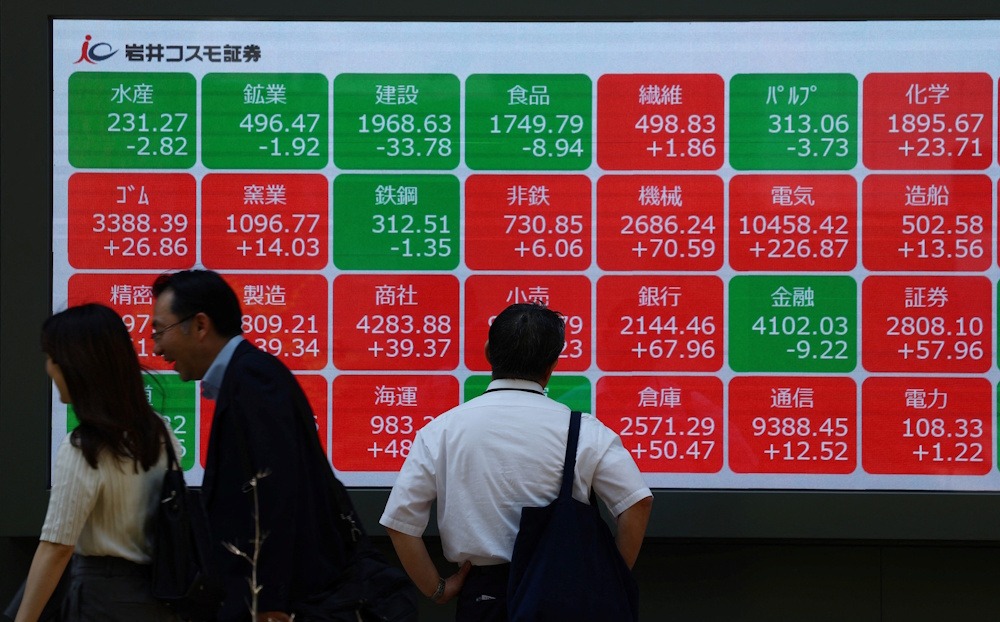
Asian shares experienced a decline on Thursday following President Donald Trump’s meeting with Chinese leader Xi Jinping. Trump described the meeting as amazing and claimed it had resolved many issues; however, investors seemed sceptical. US futures showed little movement. Tokyo’s Nikkei 225 index experienced a slight decline before edging up by less than 0.1 percent to 51,333.51, following the Bank of Japan’s decision to maintain its benchmark interest rate at the current level. Chinese markets relinquished their initial gains, as Hong Kong’s Hang Seng declined by 0.2 per cent to 26,298.64. The Shanghai Composite index experienced a decline of 0.3 percent, closing at 4,006.60. South Korea’s Kospi index surpassed the 4,000 threshold for the first time, rising 0.1 percent to 4,084.91 after an earlier increase of more than 1 percent, spurred by reports of advancements in trade discussions between Washington and South Korea. Strong corporate earnings have also propelled shares in the technology, automotive, and shipbuilding sectors. In Chinese markets, Hong Kong’s Hang Seng index experienced an increase of 0.8 per cent, reaching 26,555.36, while the Shanghai Composite index saw a modest gain of less than 0.1 per cent, climbing to 4,017.95. On Thursday, the Hong Kong Monetary Authority reduced its base rate by 25 basis points, bringing it down to 4.25 per cent. It consistently adheres to the US lead in interest rate policies, given that the value of Hong Kong’s currency is tied to the US dollar.
“The BOJ is tip-toeing towards a hike,” stated Fred Neumann. “With October having been a missed opportunity to nudge rates higher, all eyes are now on December, when a rate hike appears likely.” The Nikkei 225 experienced fluctuations, moving between gains and losses, and was last noted to be 0.2 percent higher following the Bank of Japan’s decision. While it maintained its current rates, it reiterated its commitment to raise borrowing costs further should the economy align with its forecasts. The yen reversed its earlier gains against the US dollar, now standing 0.2 percent weaker at 153.065 yen. BOJ Governor Kazuo Ueda is set to hold a press conference later today. US President Donald Trump is presently engaged in discussions with Chinese leader Xi Jinping in South Korea. US negotiators have indicated their desire to return to a delicate trade war truce; however, tensions continue to run high, and enduring economic issues are expected to linger between the geopolitical rivals. The Federal Reserve cut interest rates on Wednesday by a quarter of a percentage point as anticipated. However, the US central bank’s new policy statement highlighted several mentions of the absence of official data due to the ongoing federal government shutdown. Fed Chair Jerome Powell later informed that policymakers are likely to adopt a more cautious approach if they are deprived of additional job and inflation reports.
Trump informed that he was reducing average tariffs on Chinese goods from 57 per cent to 47 per cent, effective immediately following his first in-person meeting with Chinese leader Xi Jinping in six years. He noted advancements made by Beijing in restricting exports of fentanyl and the chemicals involved in its production. Trump also stated that China was maintaining its policy of tighter restrictions on exports of rare earths and related technologies for a year, and he anticipates that this agreement will be extended. The assertive implementation of tariffs since the commencement of the second term in the White House, coupled with China’s countermeasures on the export of rare earth elements, has imbued the meeting with a renewed sense of urgency. No immediate information regarding the details of the discussions has been provided by the Chinese side. The meeting provided an opportunity for the leaders of the world’s two largest economies to restore stability in their relations following months of turmoil regarding trade matters. On Wednesday, US stocks fluctuated near their record highs following the Federal Reserve’s actions aimed at enhancing the job market, while also cautioning that further assistance is not assured. The S&P 500 concluded the day nearly unchanged, dipping by less than 0.1 per cent. The Dow Jones Industrial Average fell by 73 points, representing a decline of 0.2 percent, while the Nasdaq composite experienced an increase of 0.5 percent.
All three indices were retreating from an all-time high. Stocks were poised for modest gains in the afternoon following the Fed’s decision to cut its main interest rate for the second time this year, aiming to support the slowing job market. However, the market took a downturn after Chair Jerome Powell cautioned that it is not a foregone conclusion that the Fed will implement another cut in December at its upcoming meeting, quite the opposite. “That needs to be taken off the board,” Powell said. Meanwhile, the influx of major US corporations disclosing their summer profits, coupled with the excitement surrounding artificial intelligence technology, is fueling growth. Companies are under significant pressure to deliver gains, as this is one method to address the criticism surrounding their soaring stock prices. In other dealings early Thursday, the benchmark US crude declined by 24 cents, settling at $60.24 per barrel. Brent crude, the international benchmark, declined by 22 cents to $64.10 per barrel. The US dollar increased to 152.94 Japanese yen, up from 152.65 yen. The euro increased to $1.1627, rising from $1.1609.