Wall Street and Asian Stocks Climb Amid AI-Fueled Market Rally

Shares experienced a rally on Thursday throughout Asia, following the upward momentum observed on Wall Street, as the pressure from the bond market subsided and oil prices retreated. The advance was also fuelled by a quarterly report from chipmaker Nvidia that exceeded expectations, with profit soaring over 200 percent in the February-April quarter compared to the previous year, while revenue surged by 85 percent. Nvidia has emerged as a significant beneficiary from the surge in artificial intelligence, driven by robust demand for its advanced AI chips. Its shares increased by 1.3 percent on Wednesday prior to the release of its earnings report; however, they subsequently declined by 1.3 percent in after-hours trading following the announcement. South Korea’s Kospi experienced an impressive increase of 8 per cent, reaching 7,787.74. This surge was bolstered by robust purchasing activity in technology stocks, particularly Samsung Electronics, which rose by 7.5 per cent following a late Wednesday agreement between its labour union and management that successfully averted a strike. Shares in SK Hynix, a computer chipmaker collaborating with Nvidia, experienced an increase of 11.3 percent. The Kospi has been setting new records, recently surpassing 8,000 for the first time. Taiwan’s Taiex, which has a significant concentration in technology shares, experienced a 3.9 percent increase, driven by a 3 percent rise in the stock of major chipmaker TSMC.
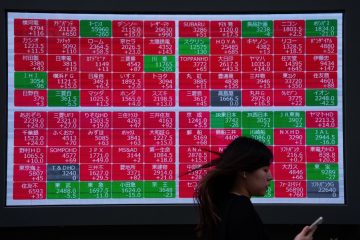
In Tokyo, the Nikkei 225 index experienced a notable increase of 3.6 percent, reaching a level of 61,930.44. The government reported that Japan’s exports rose nearly 15 percent in April from a year earlier, despite shocks from the Iran war. Chinese markets exhibited minimal movement, as Hong Kong’s Hang Seng remained steady at 25,648.28, while the Shanghai Composite index showed little variation at 4,162.37. Australia’s benchmark index advanced by 1.6 percent, reaching a level of 8,628.80. Oil prices experienced an uptick early Thursday, following a 5 percent decline in Brent crude the previous day. Brent, the international standard, increased by 95 cents to $105.87 per barrel, whereas the US benchmark crude rose by 92 cents to $99.18 per barrel. Brent continues to trade significantly above the approximately $70 mark observed prior to the conflict with Iran. Prices have been fluctuating amid alternating optimism and pessimism regarding the potential for an agreement between the United States and Iran that would facilitate the full resumption of oil deliveries from the Persian Gulf to global customers. On Wednesday, US equities experienced a rebound, as the S&P 500 increased by 1.1 percent, marking its initial rise in four days. The Dow Jones Industrial Average increased by 1.3 percent, while the Nasdaq composite experienced a rise of 1.5 percent. Stocks received a boost from declining yields in the bond market, with the yield on the 10-year Treasury decreasing to 4.57 percent from 4.67 percent late Tuesday. That represents a considerable shift for a market that quantifies changes in hundredths of a percentage point.
The 10-year Treasury yield had been increasing from below 4 percent prior to the onset of the conflict with Iran, mirroring a trend observed in government bond yields globally. This rise is attributed to concerns that the ongoing hostilities will sustain elevated oil prices, among other considerations. Concerns regarding inflation diminish the likelihood of the Federal Reserve implementing rate cuts this year and heighten the risks that global central banks may need to increase rates in 2026. Elevated yields dampen economic activity and exert downward pressure on the valuations of equities, cryptocurrencies, and various other asset classes. In addition to increasing mortgage rates, they may also restrict corporate borrowing for the construction of artificial intelligence data centers, which have been contributing to the recent growth of the US economy. As yields have eased, technology stocks have played a pivotal role in propelling Wall Street upward. Tech stocks that were at the forefront of the market included Advanced Micro Devices, which experienced an increase of 8.1 percent, and Intel, which rose by 7.4 percent. Smaller companies may experience a more pronounced sense of relief from declining yields compared to their larger counterparts, as many of these firms rely on borrowing to facilitate growth. The Russell 2000 index, representing the smallest US stocks, experienced a notable increase of 2.6 percent, significantly outpacing the S&P 500, which tracks the largest US stocks, with a gain that was more than double that of the latter.
Red Robin Gourmet Burgers experienced an increase of 18.2 percent, while Cava Group saw a rise of 3.1 percent, following profit reports that exceeded expectations. These developments have bolstered optimism that households may continue to spend and support the economy, even in the face of elevated petrol prices and a generally bleak economic outlook. Most large US corporations have disclosed stronger earnings for the beginning of 2026 than analysts had anticipated, contributing to a surge in stock prices to unprecedented levels. Stock prices generally align with the trajectory of corporate profits in the long run. Target experienced a decline of 3.9 percent, despite the retailer surpassing analysts’ expectations for profit and revenue in the latest quarter. A new CEO, Michael Fiddelke, is attempting to revitalise the company and enhance its revenue streams. In other dealings early Thursday, the US dollar appreciated to 158.98 Japanese yen from 158.92 yen. The euro maintained its position at $1.1624.