Wall Street’s Biggest Rally in 2 Months as Trump Halts Iran Strikes

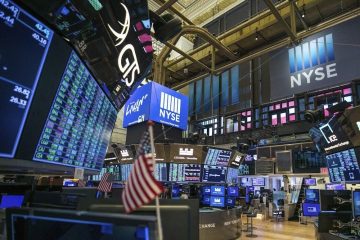
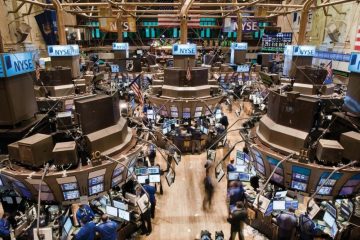
US stocks experienced a significant rally, marking their strongest performance in two months, while oil prices declined on Thursday following President Donald Trump’s decision to retract his threat of military action against Iran in the evening. That raised expectations for a possible agreement that could restore the global flow of oil. The S&P 500 surged 1.8 percent, rebounding from consecutive declines that had pulled it back to levels seen in early May. The Dow Jones Industrial Average surged by 929 points, representing a 1.9 percent increase, while the Nasdaq composite experienced a rally of 2.5 percent. Stocks quickly moved upward in midday trading following Trump’s statement on his social media platform that “discussions with the Islamic Republic of Iran have been brought to the highest level of Iranian leadership and approved” and that the time and place of a signing will “be announced shortly.” A resolution to the conflict with Iran might facilitate the reopening of the Strait of Hormuz, enabling oil tankers to transport crude oil once more from the Persian Gulf to global clients. The price for a barrel of benchmark US crude decreased by 2.6 percent to $87.71. Brent crude, the international benchmark, decreased by 2.9 percent to $90.38, yet it remains above its approximate $70 level prior to the conflict. Concerns have escalated as the United States and Iran engaged in attacks over the past several days, jeopardising a fragile ceasefire that has lasted for more than a month.
High oil prices resulting from the Iran war have driven inflation significantly higher, and a report released on Thursday indicated that prices at the US wholesale level rose more in May than economists had anticipated. The impact is global, and on Thursday, the European Central Bank took the lead as the first significant central bank to increase interest rates in reaction to the situation. Elevated interest rates can help contain inflationary pressures. However, they also impede economic growth and diminish prices across various investment categories, including equities and digital currencies. Investments perceived as particularly costly have come under scrutiny, with some critics labelling the artificial intelligence sector as a bubble, suggesting that investment levels have escalated excessively. Significant fluctuations in AI stocks have been causing the US stock market to experience volatility over the past week, transitioning from impressive highs to a sudden downturn. The primary issue at hand is whether these stocks have surged too rapidly due to the excitement surrounding AI, with their volatile movements occasionally reversing within mere hours. AI stocks were already beginning to rebound early Thursday, prior to Trump’s announcement regarding Iran.
Marvell Technology experienced an increase of 11.1 percent. It has recently experienced a volatile period, dropping 16.7 percent, rebounding with a rise of 9.6 percent, and then declining for two consecutive days by more than 5 percent. Just prior to that, it experienced a remarkable one-day increase of 32.5 percent, marking its highest performance ever, following Nvidia CEO Jensen Huang’s assertion that it could be “the next trillion-dollar company.” At that moment, its value exceeded $190 billion. Companies engaged in chip production, on the other hand, experienced some of the most significant gains in the market. Lam Research surged 12.7 percent, while KLA advanced 12.9 percent. They contributed to mitigating an 8.5 percent decline for Oracle. It reported a stronger profit for the latest quarter than anticipated, but it also indicated an expectation to raise $40 billion in cash this fiscal year through borrowing and stock sales. That follows the raising of $48 billion in the last fiscal year to support AI investments. Other companies have faced significant backlash recently for revealing substantial expenditures on AI, as uncertainty lingers regarding whether these investments will yield the profits and productivity that advocates of AI are forecasting. All told, the S&P 500 surged by 127.31 points, reaching a level of 7,394.30. The Dow Jones Industrial Average increased by 929.97, reaching 50,848.75, while the Nasdaq composite surged by 640.16, climbing to 25,809.66. In the bond market, Treasury yields experienced a significant decline as decreasing oil prices alleviated some of the upward pressure on inflation. The yield on the 10-year Treasury decreased to 4.45 percent from 4.55 percent late Wednesday, marking a notable shift in the bond market.
A sustained drop in oil prices could enable the Federal Reserve to maintain its main interest rate this year, rather than increasing it as many traders anticipated due to elevated inflation and a robust US job market. In the wake of Trump’s announcement, market participants adjusted their expectations regarding a potential rise in the federal funds rate for this year, as indicated by data from CME Group. The Fed may consider resuming its interest rate cuts under the leadership of Kevin Warsh, contingent upon a significant easing of inflation pressures. Trump appointed Warsh, and Trump has been vocally advocating for reduced interest rates. Stocks of smaller companies often experience significant advantages from lower interest rates, as many rely on borrowing to fuel their growth. The Russell 2000 index, which tracks the smallest US stocks, surged by a market-leading 3 percent. In international stock markets, indexes experienced a slight increase in Europe after a varied conclusion in Asia. London’s FTSE 100 experienced an increase of 0.5 percent, while Hong Kong’s Hang Seng saw a decline of 0.7 percent, marking two significant movements in the global market.