Jamie Dimon Warns Europe Is Losing Ground to the US Economy
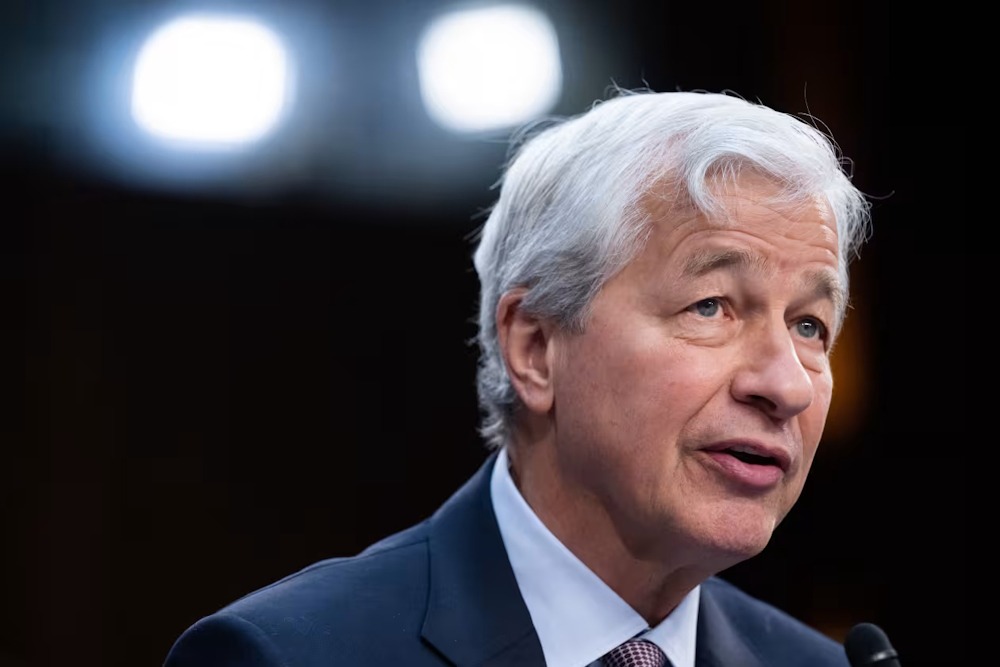
JPMorganChase Chairman and Chief Executive Officer Jamie Dimon has expressed concerns regarding Europe’s economic model, contending that elevated taxes, insufficient investment incentives, and slow growth have diminished the region’s economic position compared to the United States. During an event organised by the Council on Foreign Relations, Dimon dismissed the notion that “middle powers” could collaborate effectively to challenge larger economies, using Europe as a reference point. A video of his remarks has gained significant traction on social media. “When Mark Carney said, ‘The middle powers should get together’… it’s a fantasy… They did that, it’s called Europe,” Dimon said. “The GDP of Europe has gone from 90 per cent of America to 70 per cent. And in our view, it will probably continue to erode over time because of high taxes.” Dimon stated that the economic challenges facing Europe extend beyond just taxation.
While clarifying his support for welfare programmes, he contended that social safety systems in various countries are expensive and fail to provide adequate economic advantages. “I am not against social safety nets, but they are too high and ineffective in a lot of countries. They have 100 per cent debt to GDP also, but, you know, growing slow is much worse with 100 per cent debt to GDP than growing fast,” he said. He also criticised what he described as policies that deter investment, stating that capital typically flows to economies with more robust growth prospects. “They’re, you know, kind of anti-business, you know poor tax structures that stop investment. Capital formation generally drives growth. A lot of that capital is moving here,” Dimon stated, alluding to the US. Highlighting the disparity between American and European financial markets, Dimon noted that US stock exchanges had expanded significantly beyond their European counterparts. “Here’s some big numbers for you — our stock exchange, it is worth $60 trillion, maybe $70 trillion today. You know Deutsche Börse? Three. You know, the FTSE at UK? Four. The French one? Three. And that is serious stuff,” he stated.
Dimon also referenced a report prepared by former European Central Bank President Mario Draghi, noting that it provided a roadmap for enhancing Europe’s competitiveness. “So Mario Draghi wrote this great report. That is what they need to do: have a real European Union open, you know, trade services to everyone in there, have a big common market, have a growth strategy and policies that can drive growth. And we should help them,” he stated. Last year, Draghi emphasised the necessity for Europe to implement a new industrial strategy, advocating for an annual investment of approximately €800 billion to ensure the region’s competitiveness against the United States and China. The European Union has a population of approximately 450 million, while the United States has about 342 million. The economy is valued at approximately $20 trillion, whereas the US economy is estimated to be nearly $29 trillion to $30 trillion.
Despite the gap, Europe continues to be one of the largest consumer markets globally. Dimon has consistently emphasised that a more robust European economy would be advantageous for both sides of the Atlantic. In an interview, he stated that addressing trade disputes between the US and Europe would foster enhanced economic growth. “If you asked me what the goal should be for our economic relationship with Europe, it should be having a stronger Europe,” Dimon said. “Both the economies would grow better.” He presented a comparable argument last year, emphasising that enhanced transatlantic collaboration continued to be crucial. In an interview with Fortune, Dimon remarked, “America First is fine as long as it isn’t America alone.”