Trump: Iran’s Financial Collapse, Losing $500M Daily Due to Blockade
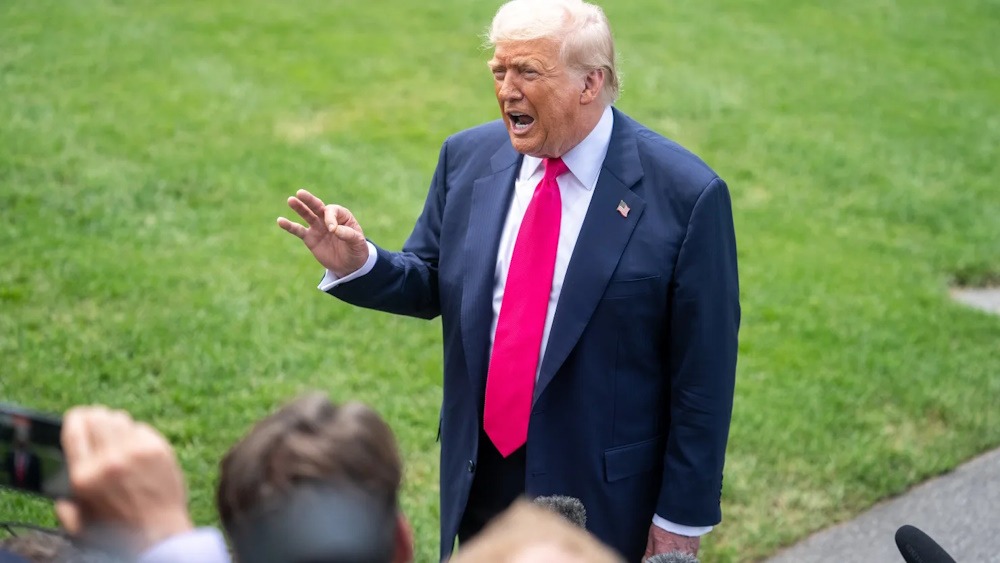
US President Donald Trump has asserted that Iran is experiencing a significant financial crisis, stating that the country is “collapsing financially” as tensions persist in the region. In a post on Truth Social, Trump asserted that Tehran is “starving for cash” and is reportedly “losing 500 Million Dollars a day.” He further stated that the Iranian leadership is facing considerable internal pressure, with the “Military and Police complaining that they are not getting paid.” The remarks from the US President arise during a continuing maritime standoff, with Trump asserting that the Iranian authorities “want the Strait of Hormuz opened immediately.” The strategic waterway has emerged as a central issue in recent geopolitical tensions, influencing global energy routes and maritime commerce.
Trump further emphasized the worsening domestic situation in Iran, characterizing the circumstances as a “SOS!!!” scenario. These assertions seem to be integral to the administration’s wider strategy aimed at emphasizing the effects of the ongoing economic and naval blockade on Tehran’s operational capabilities. In an earlier post on Truth Social the same day, the President elaborated on these claims, asserting that Tehran is privately lobbying for the reopening of the Strait of Hormuz to curb mounting economic losses, despite its public posturing of a continued standoff. Trump asserted that Iran’s overt antagonism concerning the waterway is a spectacle aimed at a political audience, rather than an accurate representation of its economic situation. “Iran doesn’t want the Strait of Hormuz closed; they want it open so they can make USD 500 million a day (which is, therefore, what they are losing if it is closed!)” he posted, suggesting the blockade is crippling the Iranian economy.
He further dismissed Tehran’s threats to keep the passage shut, characterizing them as a defensive response to US military pressure. “They only say they want it closed because I have it totally BLOCKADED (CLOSED!), so they merely want to ‘save face,'” the President added. The US leader also disclosed that backchannel communications have commenced. Trump stated that intermediaries recently reached out to indicate a change in Tehran’s stance. “People approached me four days ago, saying, ‘Sir, Iran wants to open up the Strait immediately,'” he asserted. He cautioned that an early reopening without substantial geopolitical concessions would diminish US leverage in future negotiations, asserting, “But if we do that, there can never be a deal with Iran unless we blow up the rest of their country, their leaders included!” Amidst this turbulent environment, the President declared late on Wednesday his decision to extend the existing ceasefire, aiming to create an opportunity for additional diplomatic efforts.
However, this extension is still in a delicate position, as it seems to be a “unilateral” decision, with “no immediate confirmation from Iran or Israel” regarding their commitment to uphold the truce. In contrast, commentators associated with the Iranian government have questioned the sincerity of Washington, portraying the extension as a maneuver to “gain a strategic advantage” while the “naval blockade” continues to be enforced. The stakes are significant as the original ceasefire was “set to expire shortly” prior to Trump’s intervention. Currently, the Strait of Hormuz remains central to the ongoing tensions, as its ongoing closure presents a continual risk to “international energy markets and maritime security.”