Wall Street’s tech boom hurts Asian shares in sparse holiday trade
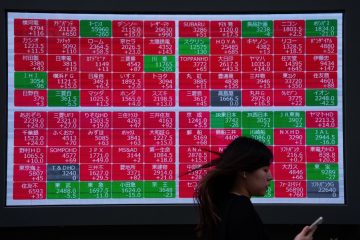
Shares experienced a decline on Friday across Asia, while markets in Greater China remained closed due to holidays. US futures declined as optimism regarding the US-Iran deal to conclude their conflict was tempered by the delay of critical discussions aimed at resuming negotiations concerning Iran’s nuclear program and facilitating oil transit through the Strait of Hormuz. US markets will be closed on Friday in observance of Juneteenth. Investor sentiment has been adversely affected by anticipations that central banks, including the Federal Reserve, will increase interest rates in an effort to mitigate inflation. Tokyo’s Nikkei 225 fluctuated between positive and negative territory, ultimately remaining relatively stable at 71,082.81. The government reported that consumer prices excluding volatile fresh foods remained unchanged; however, analysts indicated that an increase is likely in the coming months, notwithstanding the rise in fuel costs. Higher inflation influenced the Bank of Japan’s decision to elevate its benchmark interest rate earlier this week to a three-decade high of 1 per cent, marking a gradual adjustment in its policies following years of near-zero or negative rates. In South Korea, the Kospi experienced a decline of 0.5 percent, settling at 9,019.22, while the S&P/ASX 200 in Australia fell by 1.1 percent to 8,818.40.
India’s Sensex experienced a decline of 1 per cent. Markets in Hong Kong, Shanghai, and Taiwan were closed for the Dragon Boat Festival. On Thursday, stocks experienced an uptick on Wall Street, recovering a significant portion of the losses incurred the previous day and achieving weekly gains, largely propelled by substantial advancements in major technology firms. The decline on Wednesday was driven by anticipation that the Federal Reserve will likely raise interest rates this year in an effort to combat inflation. The S&P 500 experienced an increase of 1.1 percent, reaching a level of 7,500.58. The Dow Jones Industrial Average increased by 0.1 percent, reaching 51,564.70, while the Nasdaq composite experienced a notable rise of 1.9 percent, climbing to 26,517.93. Technology stocks experienced significant gains and played a crucial role in the overall ascent of the broader market. Intel experienced a notable increase of 10.6 percent following the announcement by US President Donald Trump regarding the semiconductor giant’s decision to manufacture chips for Apple within the United States. Other major semiconductor firms made notable advancements. Nvidia experienced a 3 percent increase, while Micron Technology saw a notable rise of 8.7 percent. On the losing end, SpaceX experienced a decline for the second consecutive day following its significant debut on the US stock market last week. The rocket manufacturer and AI enterprise led by Elon Musk experienced a decline of 3.6 percent, following a previous loss of 4.9 percent on Wednesday.
Oil prices fluctuated following the agreement between the United States and Iran to conclude their conflict and restore oil tanker traffic through the Strait of Hormuz. Brent crude, the international benchmark, traded predominantly in the negative territory throughout the day before ultimately closing 0.4 percent higher at $79.85 per barrel. US benchmark crude declined by 0.2 percent, settling at $75.85 per barrel. Early Friday, Brent crude was down 0.5 percent at $79.34 per barrel. US benchmark crude declined by 0.5 percent, settling at $75.37 per barrel. Airlines experienced notable increases. American Airlines experienced an increase of 3.7 percent, while United Airlines saw a rise of 2.1 percent. Cruise line company Carnival experienced an increase of 3.2 percent. Energy companies experienced a decline. Exxon Mobil experienced a decline of 2.1 percent, while Chevron saw a decrease of 2.2 percent. Crude oil prices remain elevated, hovering around $70 per barrel, a level established prior to the conflict, yet they have significantly decreased from the $100-plus mark observed just weeks ago. Elevated oil prices have been exerting pressure on markets amid the ongoing conflict between the US and Iran.
The current agreement between the nations eliminates sanctions on Iran, permitting it to sell its oil without restrictions. It also opens up the Strait of Hormuz, a critical passage through which a fifth of the global oil supply is transported. Increasing energy expenses have been exerting additional pressure on already elevated inflation levels. The average price of petrol in the US has fallen below $4 a gallon; however, it remains 25 percent higher than it was a year ago. Prices have been increasing across a broad spectrum of goods due to elevated shipping expenses. The Federal Reserve maintained its key interest rate this week; however, elevated inflation suggests that an increase in rates is probable by the year’s end. Lower interest rates facilitate borrowing for businesses and households, thereby stimulating growth; however, they also have a tendency to ignite inflation. In other dealings early Friday, the US dollar appreciated to 161.39 Japanese yen from 161.38 yen. The euro declined to $1.1441 from $1.1458.