Trump Warns US Could Strike Iran’s Underground Nuclear Site
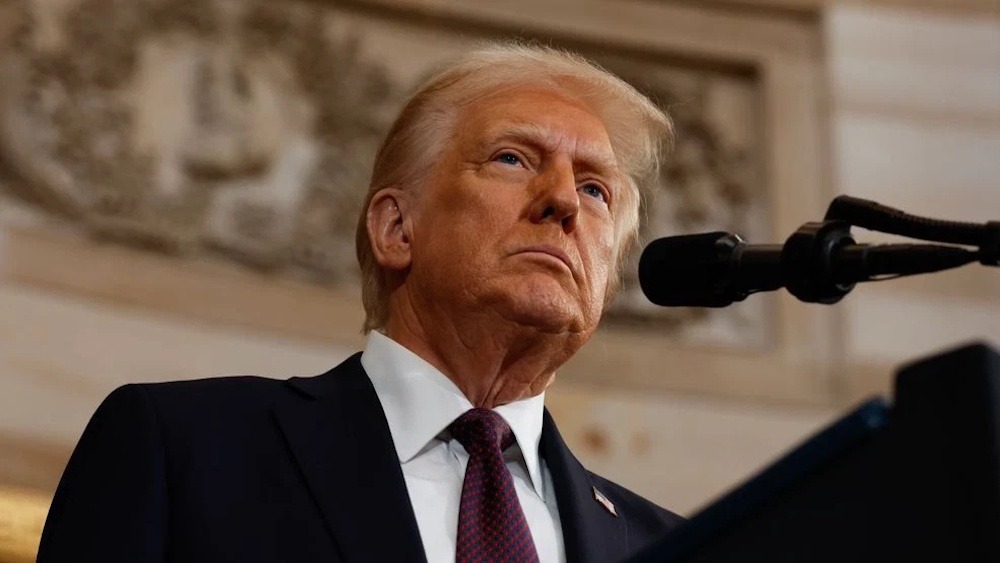
US President Donald Trump on Friday indicated that the United States could “hit” Iran’s heavily fortified underground nuclear site known as Pickaxe Mountain “very soon”, following recent actions by Washington targeting Iranian military installations. In remarks to the press at the Oval Office, Trump articulated a defence of the extended US military operation targeting the Islamic Republic, emphasising that the central aim is to thwart Tehran’s pursuit of nuclear armament. “We’re in five months now. And you know what we did in five months? They’re not going to have a nuclear weapon; that’s what we did,” Trump said. “Iran will not have a nuclear weapon because if they did, you probably wouldn’t be standing here very long,” he added.
Trump subsequently cautioned that Pickaxe Mountain might become a target should the US observe any activity in that region. “We may hit Pickaxe very soon because if there was anything going on with Pickaxe,” Trump said, adding that US intelligence was closely monitoring activity at the site. “We know everybody that’s moving at Pickaxe; we know everybody that’s moving everywhere all over Iran. And if anything goes bad, we hit them; we hit them hard,” Trump said. Pickaxe Mountain is situated in proximity to Iran’s significantly impaired Natanz uranium-enrichment facility and is characterised as a robustly fortified subterranean complex featuring two extensively buried tunnel systems. Source previously indicated that Israeli intelligence holds the view that Iran has transferred thousands of centrifuges to a facility situated deep underground. The underground construction of the site is thought to enhance its resistance to conventional aerial bombardment, rendering any potential US decision to strike it a considerable escalation in the campaign against Iran’s nuclear infrastructure.
Trump also contended that US military intervention had averted a broader regional conflict, asserting that without American action, Israel and the wider Middle East would have encountered a potentially more severe threat. “If we didn’t go in there, you wouldn’t have Israel right now, you wouldn’t have the Middle East, and they probably would go at European cities and our cities next,” Trump said. “But we stopped them from having a nuclear weapon in five months,” he added. The remarks followed closely after the US Central Command announced that American forces had concluded a series of strikes targeting Iranian military installations. Last week, CENTCOM reported that operations focused on facilities linked to Iran’s Islamic Revolutionary Guard Corps, encompassing air-defense installations, radar systems, maritime assets, mine-laying capabilities, and communications sites. CENTCOM indicated that the strikes were a response to what it characterised as recent “attempted attacks” by the IRGC on commercial shipping in the Strait of Hormuz and against US service members. Trump also addressed the recent US strikes on Iranian radar systems, asserting that American forces had successfully destroyed advanced radar installations on two separate occasions.
“There had been no shooting for days before the hit that we gave them the other night to wipe out the radar they had,” Trump said. “They had very sophisticated radar – they brought in radar because we knocked it out once, and now we knocked it out twice. Now we don’t notice any activity,” he added. Trump indicated that Iran may be hesitant to persist in the deployment of radar systems due to the frequency of US attacks. “I think they’re tired of putting it in and getting blown up,” he said. Iran has issued a strong condemnation of the recent American strikes, alleging that Washington has violated Iranian sovereignty and targeted non-military infrastructure as well as civilian sites in various provinces. Iran’s Ministry of Foreign Affairs stated that Iranian armed forces executed what it termed “crushing defensive strikes” against US military bases in West Asia, which Tehran claimed were the source, support, and staging areas for American assaults.