Global Markets Cheer US-Iran Breakthrough
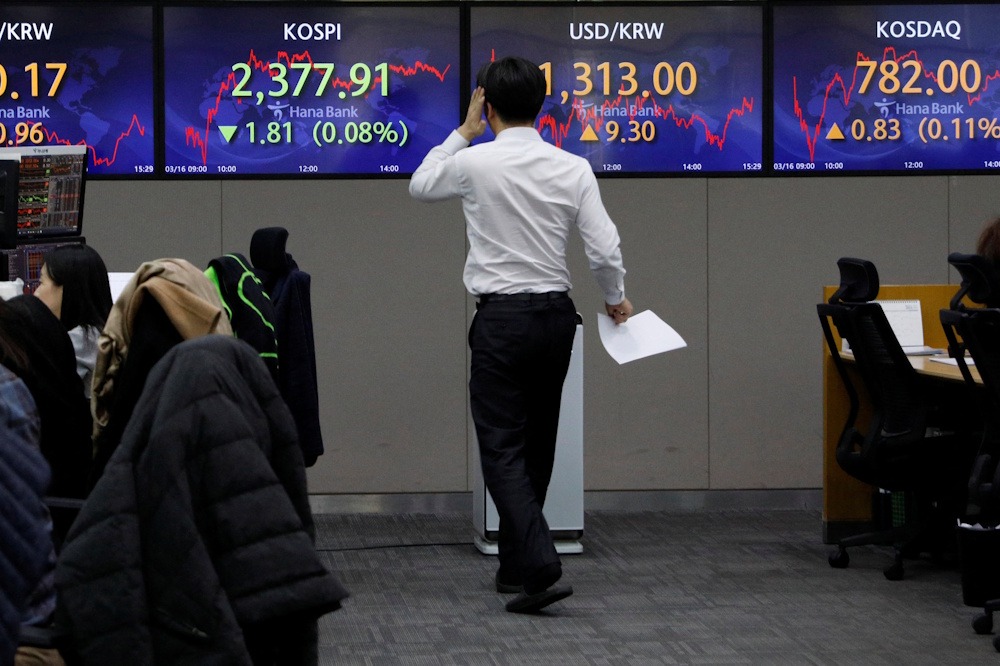
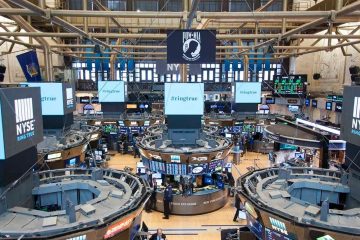
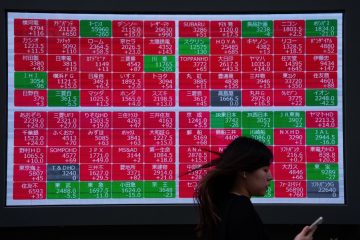
Share markets experienced a significant rise in Asia on Monday, accompanied by a decline in the dollar and a drop in oil prices. This movement follows a tentative peace agreement between the United States and Iran, which is expected to alleviate inflationary pressures worldwide and reduce the necessity for increased interest rates. Pakistani Prime Minister Shehbaz Sharif announced on social media early on Monday that a deal had been reached. Meanwhile, President Donald Trump indicated that the agreement involved the opening of the crucial Strait of Hormuz, although specifics were not provided. Trump is set to engage with Middle Eastern leaders and participate in a working session alongside Ukrainian President Volodymyr Zelenskiy at the G7 summit in France this week. Iran announced that it, along with Oman, would regulate traffic through the strait, which could undermine the principles of free trade and imply the possibility of imposing a toll on shipping. “The lack of details especially on freedom of shipping is a concern but not one that should constrain markets today as the surge in risk appetite plays out,” stated Sean Callow.
The potential for a prolonged decline in energy prices shifts the dialogue for central banks right before a series of policy decisions. The news will provide some comfort for the assembly of central banks convening this week, alleviating part of the urgency to tighten policy in order to counter an energy-induced increase in inflationary expectations. Markets had anticipated a probable agreement, but the confirmation was sufficient to drive Brent crude down by 4 percent to $83.80 a barrel, significantly below its May high of $126.41. US crude declined 4.7 percent to $80.89 a barrel, yet remained above the $67 level it was at prior to the onset of the conflict. “We see Brent oil futures falling to $80 by the end of the year assuming the strait does not close again,” stated Vivek Dhar. “Our forecast implicitly assumes that oil and refined product exports can resume quickly through the Strait of Hormuz, but this view carries considerable uncertainty tied to the damage to oil and refinery assets.” The prospect of cheaper oil presents a significant advantage for Japan, a net importer of energy, as evidenced by the Nikkei’s 3.0 percent increase. South Korea’s vibrant market surged by 4.3 percent, while MSCI’s comprehensive index of Asia-Pacific shares, excluding Japan, increased by 1.5 percent.
In Europe, EUROSTOXX 50 futures and DAX futures both increased by 0.2 percent, while FTSE futures gained 0.3 percent. S&P 500 futures increased by 0.9 percent, while Nasdaq futures rose by 1.5 percent, reflecting a broad upswing in risk assets. Central banks are scheduled to convene this week in the US, UK, Japan, Australia, Switzerland, Sweden, Norway, and Russia, with Japan being the most anticipated to raise interest rates during this meeting. The Federal Reserve is anticipated to maintain rates within the range of 3.50 percent to 3.75 percent during Chair Kevin Warsh’s inaugural meeting on Wednesday. The statement, economic projections, and news conference will be closely examined for any indications of the Fed shifting away from its easing bias as officials become increasingly concerned about inflation risks. Investors swiftly adjusted their expectations regarding a potential rate hike this year, as December futures increased by four ticks. Meanwhile, the likelihood of a move occurring as soon as October is now estimated at approximately 45 percent.
Treasuries experienced a rally as optimism grew regarding a sustainable decline in oil prices, which could mitigate the upward pressures on inflation. Yields on 2-year notes decreased by 6 basis points, settling at 4.02 percent. The decline in yields and overall enhancement in risk led to a significant depreciation of the US dollar, resulting in the euro appreciating by 0.4 percent to $1.1608. The dollar decreased by 0.2 percent against the yen, settling at 159.90, whereas sterling appreciated by 0.3 percent to reach $1.3446. The Bank of England is anticipated to maintain rates at 3.75 per cent on Thursday and throughout 2026, as policymakers appear to be in no hurry to implement tightening measures. The Bank of England’s vote split and monetary policy report will attract attention. High-quality UK data encompasses May inflation figures, retail sales, and April employment statistics. Thursday’s Makerfield election is poised to attract significant attention, as a victory for Labour Mayor Andy Burnham may pave the way for a leadership challenge against Prime Minister Keir Starmer. In commodity markets, the decline in yields facilitated a 1.9 percent increase in non-interest-paying gold, reaching $4,300 an ounce.