Asian Stocks Rise as Oil Prices Fall Post-UAE Opec Exit
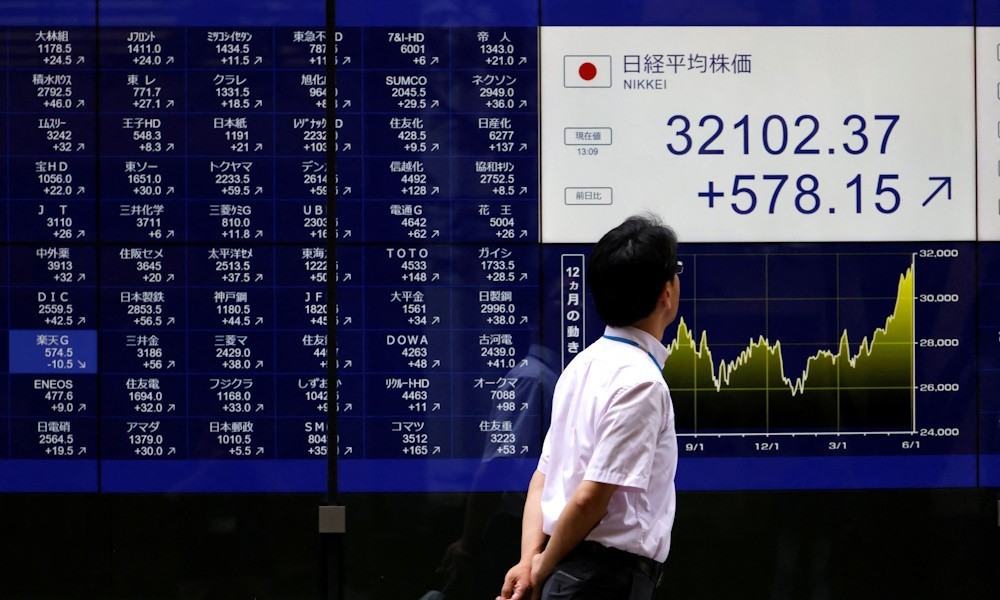
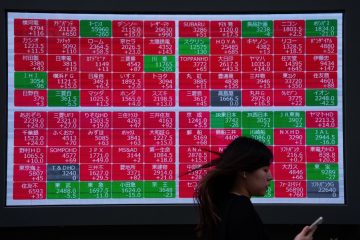
Asian stocks generally rose on Wednesday, in contrast to declines observed on Wall Street, while oil prices experienced a downturn following the announcement from the United Arab Emirates regarding its departure from Opec, posing a challenge to the influential oil cartel. US futures experienced a modest increase. The Japanese markets were closed in observance of a holiday. In other parts of Asia, the Kospi in South Korea increased by 0.3 percent, reaching 6,657.40, while the Hang Seng index in Hong Kong saw a rise of 1.4 percent, climbing to 26,029.02. The Shanghai Composite index experienced an increase of 0.3 percent, reaching a level of 4,091.01. Australia’s S and P/ASX 200 experienced a decline of 0.3 per cent, settling at 8,689.50. Taiwan’s Taiex experienced a decline of 0.6 percent, while India’s Sensex recorded an increase of 0.4 percent. The price of a barrel of Brent crude oil for June delivery decreased by 0.5 percent to $110.71 early Wednesday.
Brent scheduled for July delivery decreased by 0.6 percent, settling at $103.74. Brent oil was approximately $70 per barrel prior to the onset of the conflict in late February. Benchmark US crude declined by 0.6 percent, settling at $99.32 per barrel. The impending exit of the UAE from Opec, scheduled for Friday, has garnered significant attention from oil markets. OPEC represents approximately 40 percent of worldwide oil production, with the UAE being one of its foremost oil producers. It has resisted OPEC production quotas in recent years, seeking to increase its oil sales to the global market. According to a research note released on Wednesday by Warren Patterson and Ewa Manthey, the UAE’s exit is expected to lead to an increase in output. “In recent years, the UAE has expressed growing frustration regarding its output, which has been limited by Opec production quotas, preventing it from reaching its full potential.”
However, with US-Iran negotiations for a definitive conclusion to the Iran war having stalled and the Strait of Hormuz—through which approximately one fifth of the global oil supply flowed prior to the conflict—remaining predominantly closed, the immediate effects on oil prices will continue to hinge primarily on the likelihood of reopening this critical waterway, analysts indicated. Prior to the Iran war, the UAE ranked as the third largest oil producer among Opec members. Source stated that its exit “will reduce Opec’s effectiveness in managing and influencing the global oil market through supply measures”. Investors are keenly anticipating further developments regarding US-Iran peace negotiations, despite the minimal advancements observed thus far. Iran has proposed to reopen the Strait of Hormuz contingent upon the United States lifting its blockade on its ports. The United States seems to be dismissing the possibility of an agreement that does not encompass the nuclear program of the Islamic Republic. The Federal Reserve is anticipated to reveal its decision regarding interest rates later on Wednesday. On Tuesday, the financial markets experienced a pullback from their recent record highs.
The benchmark S and P 500 experienced a decline of 0.5 percent from its most recent all-time high, settling at 7,138.80. The Dow Jones Industrial Average decreased by 0.1 percent, settling at 49,141.93, while the technology-focused Nasdaq composite fell by 0.9 percent to 24,663.80. Stocks associated with artificial intelligence experienced the most significant declines. Broadcom experienced a decline of 4.4 per cent, Nvidia saw a decrease of 1.6 per cent, and Micron Technology faced a loss of 3.9 per cent. On Wednesday, Alphabet, Amazon, Microsoft, and Meta Platforms will disclose their quarterly results. In other transactions early Wednesday, the US dollar appreciated marginally to 159.63 Japanese yen from 159.62 yen. The euro was valued at $1.1708, a decrease from $1.1712. The yield on the US 10-year Treasury held steady at 4.35 percent.