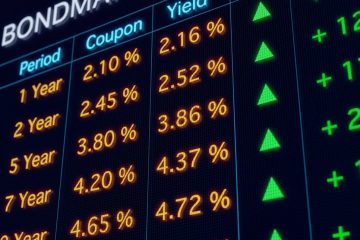
Global Selloff Drives 30-Year Treasury Yield to 2004 High

US long-term Treasury yields reached their peak in over twenty years on Thursday, continuing a worldwide decline in government bonds. The yield on the US 30-year Treasury bond increased to 5.48 per cent, marking its highest level since 2004. The benchmark 10-year Treasury yield also climbed to 5.20 percent, source reported. The report indicated that investors express concerns regarding the potential for sustained inflation, driven by elevated energy prices, robust economic growth, and increased government expenditure. Bond markets in major economies have faced sustained pressure for several months, resulting in yields reaching multi-year highs. The increase in energy prices subsequent to the Iran conflict, coupled with apprehensions regarding elevated government expenditure, has intensified the existing pressures.
The recent increase in yields has heightened apprehensions, given that the US Treasury market stands as the largest and most influential government bond market globally. The 10-year Treasury yield surpassed 5 percent this month. The level has only been reached briefly in recent decades, prompting investors to consider 6 per cent as a possible next threshold, the report stated. A further rise could exert pressure on financial markets and corporations by increasing the cost of borrowing. Thus far, investors have managed to accommodate elevated yields, as the US economy continues to exhibit robustness. Corporate profits have demonstrated resilience, while substantial investment associated with the artificial intelligence surge has bolstered economic activity. However, elevated borrowing costs are starting to impact consumers. US 30-year mortgage rates currently stand approximately one percentage point higher than their pre-Iran war levels, hovering around 7 percent, which is near the peak observed in the past two years, according to the report. The 10-year Treasury yield has increased by 0.70 percentage point since the Federal Reserve’s June policy meeting and by 1.25 percentage points since early March.
Long-term borrowing denotes the funds acquired by governments, corporations, or households that necessitate repayment over an extended timeframe, typically spanning multiple years or even decades. For the US government, the 30-year Treasury bond serves as a primary instrument for long-term borrowing. Investors acquire these bonds and, in exchange, receive interest payments from the government. When the yield on these bonds increases, it indicates that the government must provide investors with a greater return to secure borrowing over an extended duration. In straightforward terms, the expense associated with long-term borrowing increases. This may yield broader implications. Elevated government borrowing costs can lead to an increase in expenditures on interest payments. Companies may encounter increased expenses when they seek to raise capital through debt, whereas households might experience elevated mortgage and other loan interest rates. The 10-year and 30-year Treasury yields hold significance that extends beyond the confines of the bond market. They exert an influence on borrowing costs throughout the broader US economy. Shorter-term Treasury yields exhibit a stronger correlation with anticipated Federal Reserve interest-rate decisions. The 30-year yield, in contrast, indicates investor perceptions regarding the risks and returns associated with lending to the US government over an extended period of time.
The pressure extends beyond the borders of the United States. Major economies are encountering elevated borrowing costs as governments ramp up spending and accumulate debt. Germany’s finance agency announced on Thursday that federal borrowing is projected to hit a historic €525.5 billion in 2026. It is anticipated to increase further in the coming year, primarily due to elevated refinancing demands and expanding needs for specialised funds. Germany’s benchmark 10-year Bund yield briefly surpassed 3.6 percent this month, marking its highest level in 17 years. Japan’s bond yields increased on Thursday, with the 10-year Japanese Government Bond yield attaining its highest level since 1996. The benchmark yield increased by 10 basis points to 3.075 percent, while the five-year yield also rose by 10 basis points, reaching a record 2.375 percent.