South Korea to Launch Underwater Data Center Amid AI Surge
South Korea is exploring underwater options for constructing data centers, driven by the swift growth of artificial intelligence, which is exerting strain on land, power, and cooling resources, as reported. The city of Ulsan is in the process of developing an underwater data center off its coast, which has the potential to accommodate 100,000 servers in the future. The project, spearheaded by Ulsan and the Korea Institute of Ocean Science and Technology, secured 40 billion won in central government funding over a five-year period. The broader development program is budgeted at 51.1 billion won and aims to produce a standardised underwater data-centre model by 2030, according to the report.
The proposed facility would be located approximately 20 meters beneath the sea surface, utilising seawater as the principal cooling medium. The coastal waters of Ulsan exhibit an average annual temperature of approximately 13.3 degrees Celsius, providing the project with a natural reservoir of relatively cool water for the effective dissipation of heat generated by high-performance servers. The appeal is clear: cooling represents one of the most significant energy demands in a data center. KIOST research has indicated that utilising seawater for cooling purposes could significantly lower electricity consumption associated with cooling, while prior analyses of the Ulsan project projected carbon reductions of approximately 12 percent. The experiment arises as South Korea’s aspirations for AI infrastructure encounter tangible limitations. According to CBRE Korea, the power supply for data centers in the Seoul metropolitan area is projected to surpass 1,450 MW by 2028.
However, the accessibility of electricity is increasingly emerging as the critical determinant in the location of new facilities. Out of 522 applications for power-system impact assessments in the region, which account for a total of 33,592 MW of requested capacity, a mere 10 had secured final approval by March 2026, resulting in an approval rate of only 1.9 percent. Ulsan’s strategy does not involve merely submerging traditional servers. The project encompasses pressure-resistant enclosures, modular server and power systems, as well as high-efficiency hybrid cooling technology. The city is collaborating with 12 organisations from industry, academia, and research, including KIOST, Ulsan National Institute of Science and Technology, POSCO, GS Engineering & Construction, and SK Telecom. SK Telecom is tasked with the development of the AI GPU infrastructure and the server-operation model.
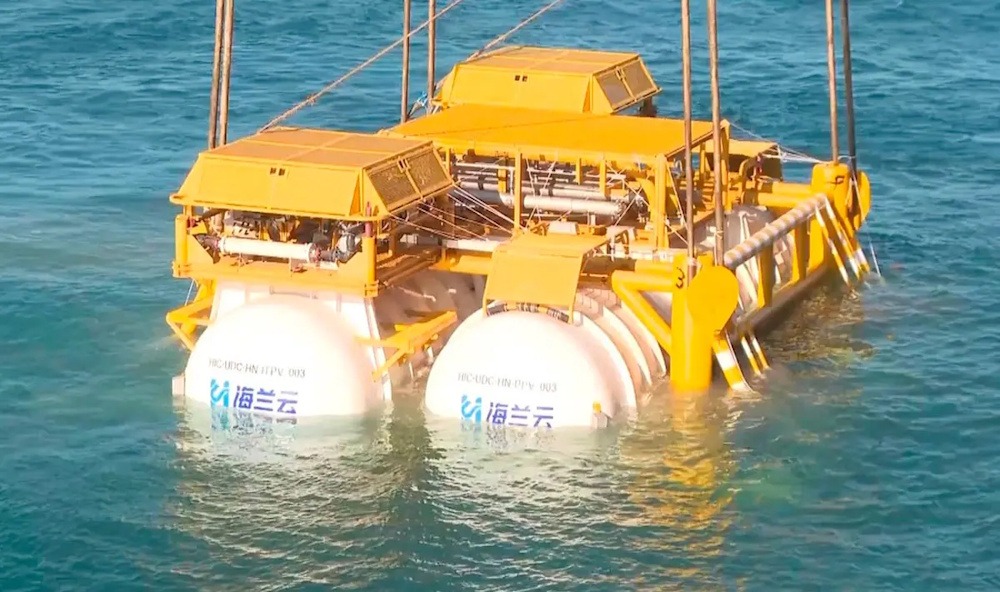
The commercial phase is anticipated to commence following the demonstration program, with Ulsan aiming for the construction of a more extensive underwater data-centre complex starting in 2031. A separate Ulsan plan envisions an investment of approximately 500 billion won in an underwater complex designed to house 100,000 servers. South Korea is not isolated in exploring this concept. China has an operational underwater data-centre project, while Microsoft has previously tested subsea servers thru its Project Natick. In May, China’s HiCloud announced the operational status of a 24 MW offshore wind-powered underwater data center located off the coast of Shanghai.