Equities Surge as Trade Tensions Ease, Boosting Investor Confidence
On Tuesday, equities experienced a slight increase, buoyed by the prospect of reduced trade tensions between the US and China, alongside a calming of concerns regarding credit risks in the banking sector, which subsequently led to a decline in gold prices. In Asia, the strong likelihood of Sanae Takaichi ascending to the position of Japan’s next prime minister briefly propelled Tokyo’s Nikkei to a record high and impacted the yen. US President Donald Trump expressed his anticipation of achieving a fair trade deal with Chinese President Xi Jinping during their upcoming meeting next week in South Korea, while minimizing the potential for conflict regarding the Taiwan issue. The potential for a resolution contributed to an uplift in investor sentiment, complemented by an agreement between Australia and the United States regarding the supply of rare earth materials.
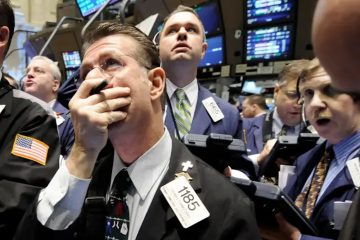
Investor confidence faced a significant blow last week as a series of problematic loans at US regional banks sparked worries about credit risks that could potentially extend into the wider markets. The extended US government shutdown has also impacted risk assets. However, these concerns have lessened to some extent, encouraging investors to seize the opportunity to buy the dip in anticipation of earnings reports from several major companies. “The market has hurdled the wall of worry with ease, with new capital injected into risk and fresh oxygen into the market’s lungs,” said Chris Weston. Philip Lane on Tuesday issued a stark warning for euro zone banks, stating they could face pressure in a scenario where dollar funding diminishes. “The combined presence of substantial $-denominated off-balance sheet exposures and volatile funding means that sudden changes in these net exposures cannot be ruled out,” he stated.
He pointed to April’s severe market turmoil, during which the dollar and safe-haven US Treasuries experienced significant sell-offs, which he indicated complicated euro zone banks’ ability to depend on their dollar-denominated liquid assets. Chris Scicluna noted that Lane’s remarks highlighted the apprehension among investors regarding the accumulation of risk within certain segments of the US financial sector, particularly as they increasingly invest in areas like AI or credit, and the potential consequences if those trends were to reverse. “One of the significant areas of attention has been the private credit strains recently affecting the regional banks. And quite clearly, if there’s a sudden pullback in or sudden problems in the US financial sector, it will have a significant impact on European banks and others,” he said. “The tone of the speeches out of the Governing Council has been, on balance, becoming more cautious, more attuned to risks and downside risks,” he added. The ECB, which convenes next week, is not anticipated to implement a rate cut in the near future, in contrast to the Federal Reserve, which may enact as many as three rate cuts over the next six months, according to market-based expectations.
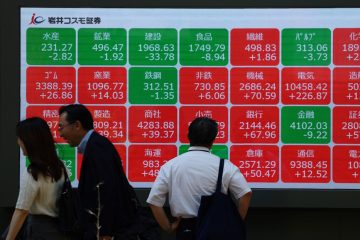
The prospect of a series of US rate cuts, coupled with remarks from adviser Kevin Hassett indicating that the federal government shutdown is expected to conclude this week, also motivated investors to re-enter the equities market. A significant rally propelled all three major US stock indexes to a notably higher close overnight, with chip stocks reaching a record high. In Europe, the STOXX 600 increased by 0.1 percent, trading just below record highs, while US stock futures dipped by 0.1 percent. Analysts currently anticipate third-quarter S&P 500 earnings growth, on aggregate, of 9.3 percent year-on-year, reflecting an enhancement over their previous estimate of 8.8 percent growth as of October 1. The dollar appreciated by 0.7 percent against the yen, reaching a value of 151.83. Takaichi is anticipated to support stimulus measures and oppose additional interest rate increases, which could negatively impact the Japanese currency and bonds, while benefiting equities. The Nikkei reached an unprecedented high, coming close to the significant milestone of 50,000 points. The Bank of Japan is scheduled to convene next week. Traders are assigning a 20 per cent probability to a rate hike, while Governor Kazuo Ueda has maintained ambiguity regarding the timing of such a decision by providing limited insights. Gold prices experienced a decline of 2 percent, settling at $4,262 an ounce, slightly below Monday’s record high of $4,381.21 an ounce.