Investors analyze software stocks amid AI disruption risks

For years, software companies enjoyed significant acclaim from investors. The combination of elevated profit margins, minimal capital needs, and significant potential for expansion led venture capitalist Marc Andreessen to assert in 2011 that “software is eating the world.” Fourteen years later, artificial intelligence is generating a comparable sense of optimism, with certain investors positioning themselves to capture a significant portion of the software industry as it potentially transforms into a lucrative opportunity.
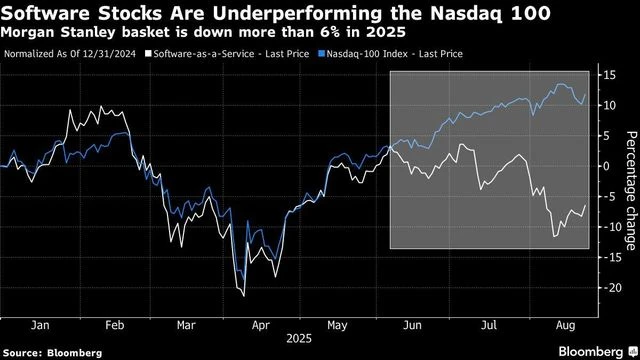
Salesforce Inc., Adobe Inc., and ServiceNow Inc. have experienced significant declines in the S&P 500 this year, with losses exceeding 17 percent, translating to approximately $160 billion in total market value erosion. Data from EPFR indicates that investors withdrew funds from the software and services sector for two consecutive months leading up to June, following a single monthly drawdown in the preceding 18 months. A Morgan Stanley basket of software-as-service stocks has experienced a decline exceeding 6 per cent this year, in contrast to an 11 per cent increase for the tech-heavy Nasdaq 100. The bank refrains from revealing the constituents of the group; however, it is noteworthy that Asana Inc., Hubspot Inc., Bill Holdings Inc., and Vertex Inc. represent some of the most significant underperformers in the software sector, each experiencing declines of no less than 29 percent.
As AI poses a potential disruption across various sectors, including education and staffing services, investors are increasingly focused on the more immediate risks facing software companies that develop the underlying code for digital services such as customer relationship management and back-office operations. “Tech obsolescence can come out of nowhere,” stated Robert Ruggirello, chief investment officer at Brave Eagle Wealth Management. “There’s good reason people are growing cautious.” The apprehension, although detrimental to equity valuations, does not imply that investors have entirely lost confidence in the sector. Indeed, Microsoft Corp., Oracle Corp., and Palantir Technologies Inc. represent key players in the software sector and have distinguished themselves as some of the top performers within the S&P 500 this year. The distinction between these companies and Salesforce and Adobe lies in their proactive approach to AI. They are perceived as engaging in offensive strategies rather than merely defending their market positions, while major tech firms allocate substantial resources—amounting to tens of billions—to enhance their AI product offerings and computing capabilities.
Meta Platforms Inc. is experiencing a notable increase in revenue growth, driven by its investments in AI that enhance ad targeting and engagement. Palantir’s AI products are projected to drive a sales growth of 45 percent this year. Crowdstrike Holdings Inc. and various other cybersecurity stocks have experienced significant growth as investors speculate that AI will not readily supplant their services. For numerous software companies, however, the danger is quite tangible as AI threatens to disrupt the industry’s value proposition of delivering digital tools that enhance productivity at elevated prices. If cost-conscious customers, such as banks or retailers, can access nearly identical services at significantly lower prices, it can lead to the dismantling of entire business models. While the potential for AI to supplant Asana’s work management software remains uncertain, the deceleration in customer acquisitions during the first quarter has generated sufficient concern, leading to a decline in share value. HubSpot, too, may have the capacity to adjust to AI advancements; however, there are concerns among investors regarding the potential for increased competition facing its CRM tools. Monday.com presents a comparable narrative. The firm’s software designed to centralize workflow processes appears resilient against obsolescence; however, investor sentiment is clouded by concerns that AI may hinder growth potential. On August 11, the lackluster revenue forecast released on Monday triggered a significant sell-off, resulting in a 30 percent decline in the company’s share price on that day.
)
“Any company wedded to old tech is going to suffer or have to pivot, and you’ll see that in the shares unless they succeed,” stated Mark Bronzo, chief investment strategist at the Rye Consulting Group. Currently, market participants are divesting from the equities of software firms that lack robust AI strategies or clear safeguards against the emerging technology. “Historically, investors have tended to revisit companies such as Salesforce and make purchases when the stock price becomes attractive in relation to its historical valuation,” Bronzo stated. “We are currently not observing that type of mindset.” The repercussions extend beyond US firms. SAP SE, recognized as Europe’s largest company by market capitalization, experienced a decline alongside smaller counterparts such as Sage Group Plc and Dassault Systemes SE in response to Monday.com’s cautionary statement.
OpenAI’s ChatGPT has reached approximately 700 million weekly users, prompting Ruggirello to compare software firms to “an energy company waking up and realizing there’s now a company the size of Exxon it’s competing with.” The apprehension is reflected in the sector’s valuations, which have historically exceeded those of the broader market owing to swift sales growth and subscription models, attributes that are highly valued by Wall Street for their dependable revenue streams. The Morgan Stanley software basket reached a valuation of 23 times projected earnings this month. This figure represents 50% of the average observed over the previous ten years and marks the lowest point recorded in Bloomberg data since 2014. The Nasdaq 100 is currently valued at just below 27 times its projected earnings.
Strategists at UBS indicated that the downturn in certain segments of the software sector may present potential opportunities. Earlier this month, a recommendation was made for investors to consider internet and software firms that have underperformed in the current AI enthusiasm. “While AI revenue growth has yet to match the industry’s aggressive spending, rising monetization and AI adoption trends have been encouraging,” strategists led by Ulrike Hoffmann-Burchardi, chief investment officer Americas and global head of equities, noted in a research report. Nonetheless, the current apprehension among investors regarding software is evident. Over the two decades leading up to the 2021 market peak, the software and services sector within the S&P 500 experienced the most significant increase in its index weighting, rising from under 6 percent to almost 14.5 percent, despite the reclassification of companies such as Google, Facebook, and Amazon.com into different sectors in 2018. The group’s significant presence in the market capitalization-weighted S&P 500 currently accounts for approximately 12 percent of the benchmark, having been surpassed by semiconductor firms that are capitalizing on the increasing demand for computing hardware. The software group’s weighting would be even lower were it not for the outperformance of Microsoft, Oracle, and Palantir. “The perception is that risk has gotten much higher, and we’re not going to get clarity anytime soon,” stated Ruggirello from Brave Eagle. “Currently, it appears that a select number of firms, such as Meta and Microsoft, are demonstrating a consistent pattern of success, and they continue to thrive.” It certainly isn’t everyone.