The Strait of Hormuz is first crossed by French and Japanese ships
A French container ship and a Japanese-owned tanker have navigated the Strait of Hormuz, marking what seems to be the inaugural transits since the conflict in Iran closed this vital maritime route. The CMA CGM Kribi container ship departed the strait on Friday, as indicated by ship tracking data. This marks the first vessel associated with Western Europe that is confirmed to have successfully navigated through since the onset of the conflict over a month ago. Japan’s Mitsui OSK Lines confirmed on Friday that the liquefied natural gas tanker it part-owns has also crossed — marking another first. Traffic in the Strait of Hormuz has effectively come to a standstill following the US and Israel’s military actions against Iran, resulting in only a minimal number of vessels managing to navigate the passage. The vessels involved have predominantly been linked to countries that maintain amicable relations with Tehran, leading to the establishment of a system in which Iran grants prior approval for transit along a route that closely follows its coastline. The presence of French and Japanese vessels suggests a potential shift in dynamics, although it remains uncertain whether this development stems from formal government diplomacy or informal negotiations conducted by corporations and their intermediaries. Earlier this week, both France and Japan advocated for a ceasefire, with President Emmanuel Macron emphasizing the necessity of reopening the strait, contingent upon the cessation of bombing activities.
In the context of the evolving Iranian system observed in recent weeks, it has been reported that certain vessels are required to pay transit fees to Tehran. A representative for Mitsui OSK refrained from providing commentary on the potential fee associated with the Sohar LNG tanker. CMA CGM SA, the proprietor of the French vessel, similarly refrained from providing any commentary. France’s ministry of finance has not provided a response to the request for comment. The French Ministry of Foreign Affairs refrained from providing any commentary. CMA CGM ranks as the third-largest container shipping line globally and is predominantly owned by the affluent Saadé family. The founder, having immigrated to France from war-torn Lebanon, established the line in 1978 in Marseille. Up to this point, the majority of vessels traversing the strait have maintained amicable relations with Iran, with certain nations like Pakistan engaging in bilateral agreements to ensure secure passage. Many have been observed following a trajectory that closely aligns with the Iranian coast; however, in recent days, an alternative route has surfaced — one that traverses the Omani coastline. The LNG vessel navigated that course, accompanied by two oil supertankers. Iran, in the meantime, is implementing measures to solidify its control over the strait in the long term, working towards the establishment of a toll system for a waterway that is vital for the global supply of oil and gas. This situation is concerning for Gulf Arab states that depend on the waterway for their exports, and it would also create challenges for consumers. Iran has suggested it could implement a new system in collaboration with Oman, although Muscat has not yet articulated its position.
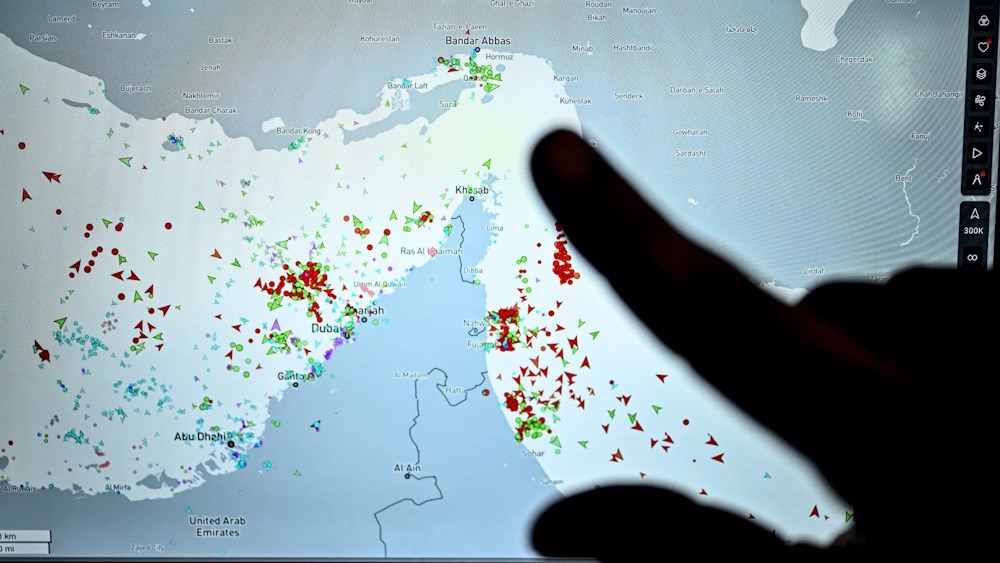
Monitoring maritime traffic through the Strait of Hormuz presents significant challenges, exacerbated by the prevalent signal jamming and the manipulation of signals in the region. The data indicate that the CMA CGM Kribi, registered under a Maltese flag, departed from waters near Dubai heading towards Iran on Thursday afternoon local time, suggesting that its ownership is French, as per ship-tracking information. The vessel maintained proximity to the Iranian coastline, navigating a channel situated between the islands of Qeshm and Larak, while transparently transmitting its course. On Friday, it indicated that it was no longer in Muscat. The CMA CGM Kribi has a capacity of approximately 5,000 twenty-foot equivalent units, or TEUs, and current draft measurements suggest that it is heavily laden with cargo, as evidenced by its low position in the water. The company has reported that 14 of its vessels are currently immobilized in the Persian Gulf, unable to navigate through the strait.
The Sohar LNG tanker, seemingly devoid of cargo, is presently situated in waters close to Muscat following a modification in its destination to the Qalhat LNG export terminal in Oman, as indicated by the data. The vessel, indicating its Omani registration, has been navigating the Persian Gulf for the past month, according to the data. The ship’s manager, identified as Oman Ship Management Co. in the Equasis database, has not yet provided a response to inquiries made via phone or email. The owner, Energy Spring LNG Carrier SA, possesses identical contact information as that of its manager. Energy Spring represents a joint venture in which Mitsui OSK holds a 50% ownership stake, as indicated by the documentation from the Japanese firm. According to the Turkish government, a second vessel departed the strait in recent days, as announced late Friday.