France’s Financial Crisis Puts the Government on the Edge

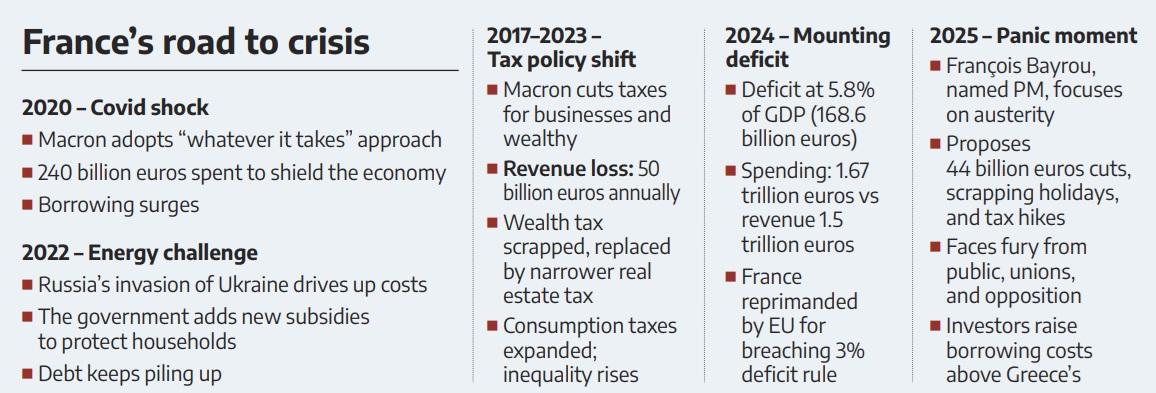
Italy historically represented a case study in political instability within Europe, characterized by escalating debt and deficits, alongside limited avenues for remediation. Currently, the focus shifts to France, where the circumstances are poised to deteriorate further. On Monday, it is anticipated that President Emmanuel Macron’s administration will experience its second collapse within a mere nine-month period, following a confidence vote in Parliament. The French Prime Minister, François Bayrou, initiated a vote aimed at reinforcing backing for his strategy to rectify the nation’s fiscal situation through 44 billion euros in expenditure reductions. Should the vote not favor him, Bayrou will be compelled to step down, necessitating Macron to appoint yet another prime minister, who will then be tasked with the urgent responsibility of addressing France’s Budget.
At first glance, the economy of the country, which ranks as the second largest in Europe following Germany, seems robust. Prior to President Trump’s tariff war, economic growth exhibited a slow yet consistent trajectory, accompanied by a gradual improvement in employment levels. In the background, excessive government expenditure coupled with declining tax revenues has put pressure on fiscal stability. The European Commission, the EU’s executive branch, issued a reprimand to France last year, prompting Macron’s government to swiftly address the escalating debt and deficit through reductions in the welfare state and increases in taxation. However, these initiatives were put on hold last summer when Macron unexpectedly disbanded the lower house of Parliament, the National Assembly, in a strategic move aimed at curbing the influence of the Far-Right party, the National Rally, led by Marine Le Pen.
The strategic maneuver ultimately proved counterproductive, resulting in a significantly polarized Parliament and the ascension of a new prime minister, Michel Barnier, whose administration was dismissed after a mere three months in office. Bayrou was appointed shortly thereafter and prioritized the reduction of the deficit as the cornerstone of his administration’s strategy. Recently, Bayrou cautioned that the nation confronted a financial crisis if it did not take decisive action. He suggested a series of significant reductions in public expenditure and increases in taxation, alongside the elimination of two French holidays, which triggered widespread public outrage. Bayrou has been attempting to reduce government expenditure, which has historically been the highest in Europe, for a specific purpose: A significant portion of this spending is allocated to support a robust social welfare system.
In 2024, France’s budget deficit amounted to 168.6 billion euros, representing 5.8 percent of its economic output. This figure marks the highest deficit since World War II and significantly exceeds the 3 percent threshold mandated within the eurozone framework. The government generated 1.5 trillion euros in revenue; however, expenditures amounted to 1.67 trillion euros, encompassing both national and local government operations as well as the social safety net. Some of the excess expenditure can be attributed to the unforeseen dual disruptions of the Covid pandemic and the European energy crisis triggered by Russia’s invasion of Ukraine. France represents a significant economic entity and is unlikely to face bankruptcy. It is certainly not comparable to Greece, which came close to fracturing the eurozone over a decade ago due to its inability to control its fiscal situation. France retains the ability to access financial markets for borrowing, in contrast to Greece, which has been excluded from such opportunities.