US Jobless Claims Drop to 231,000 After Recent Spike
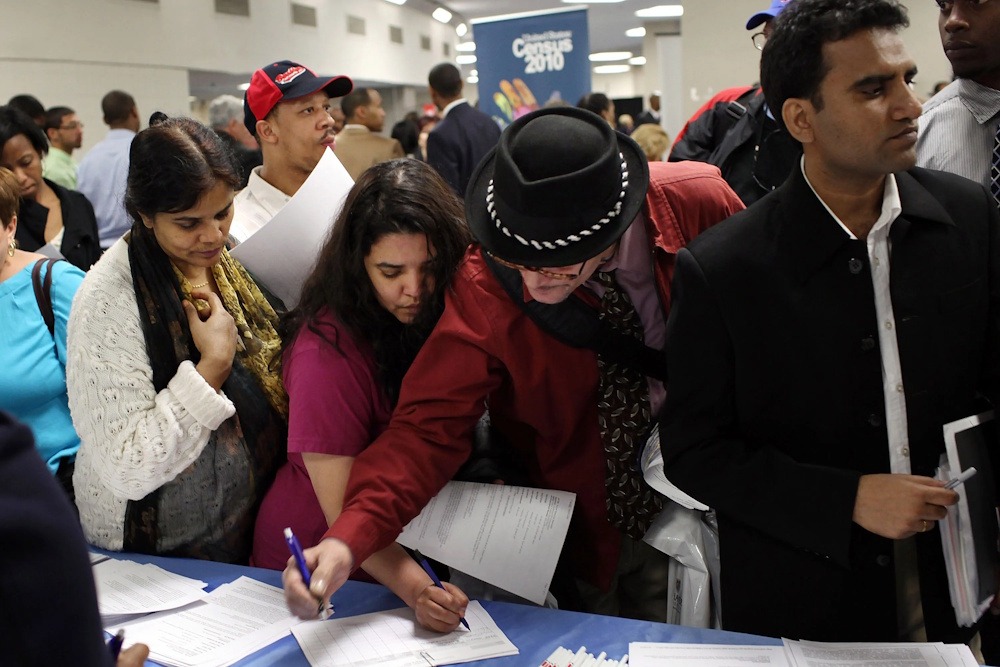
Last week saw a decline in the number of Americans submitting new unemployment benefit applications, bouncing back from the previous week’s surge. However, the labor market is showing signs of weakening, with both the demand for and supply of workers decreasing. While the report on Thursday indicated that layoffs are still quite low, the hiring aspect of the labor market has nearly come to a standstill. The pace of hiring has taken a hit, as economists point to the cloud of uncertainty created by import tariffs.
Simultaneously, a tightening of immigration policies has led to a decrease in labor supply, resulting in what Federal Reserve Chair Jerome Powell referred to on Wednesday as a “curious balance.” Economists celebrated the drop in applications, viewing it as a testament to the economy’s strength. There were suggestions that the worries of the U.S. central bank regarding the labor market might be exaggerated, indicating that additional interest rate cuts may not be necessary. “We were all hit hard by the wave of negative chatter surrounding the labor market in the Fed’s statements and Chair Powell’s remarks yesterday,” stated Carl Weinberg. “The ongoing pattern in claims persists at a level that is far too minimal to indicate a recession.” This also weakens the push for larger and more frequent rate reductions, both from the Fed and within the markets. For the week ending September 13, initial claims for state unemployment benefits saw a notable drop of 33,000, landing at a seasonally adjusted total of 231,000. Last week, claims surged to 264,000, a figure reminiscent of October 2021.
The surge in applications was primarily seen in Texas. Since the Labor Day holiday on September 1, there has been a noticeable rise in identity fraud claim attempts targeting the unemployment insurance system. It is anticipated that 240,000 claims for the most recent week. Last week saw a significant decline in unadjusted claims, plummeting by 10,384 to a total of 194,478, particularly in Texas, Connecticut, and Michigan. The declines here significantly outweigh the substantial rises seen in New York, South Carolina, and Massachusetts. Federal workers saw a notable uptick in claims, submitted through a distinct program and with a one-week delay. Next month might see an uptick in filings as severance payments for numerous public workers come to a close on September 30. On Wednesday, the U.S. central bank made a move by lowering its benchmark overnight interest rate by a quarter of a percentage point, bringing it to the 4.00%-4.25% range. They also forecast a consistent pace of reductions throughout 2025 aimed at supporting the labor market. In January, the Fed decided to hit the brakes on its policy easing cycle, grappling with the unpredictable effects of President Donald Trump’s import tariffs on inflation.
Trade policy remained a potential threat to the economy, as the Conference Board’s leading indicator, which predicts future economic trends, dropped by 0.5% in August following a slight increase of 0.1% in July. The Conference Board pointed to “increased tariffs” as the reason behind the slowdown highlighted by the leading indicator. US stocks are on the rise! The dollar surged ahead, outperforming a range of currencies. U.S. Treasury yields climbed higher.
The claims data spanned the timeframe when the government conducted surveys of business establishments for the nonfarm payrolls segment of September’s employment report. Claims experienced a slight dip between the survey weeks of September and August. In August, payrolls saw a modest rise of just 22,000 jobs, while the average employment gains for the past three months stood at 29,000 positions per month. The jobless rate is hovering close to a four-year peak at 4.3%. Last week, the government revealed that payroll figures might have been inflated by a staggering 911,000 jobs over the year leading up to March. The sluggish hiring tempo results in extended periods of joblessness for individuals who find themselves out of work. The latest report revealed a drop of 7,000 in the number of individuals receiving benefits after the first week of assistance, bringing the total to a notable 1.920 million for the week ending September 6.
A drop in the continuing claims was partially attributed to a clerical mistake. During the review period, the total number of continuing claims in the state was reported at just 205. The total reached 20,535 for the week that wrapped up on August 30. “As a result, once the data is adjusted, we anticipate the national continuing claims figure to increase by approximately 20,000,” stated Abiel Reinhart. “That would still keep claims within the levels seen in previous weeks.” It’s possible that some individuals have reached the end of their eligibility for unemployment benefits, which are typically capped at 26 weeks in many states. This may explain the recent dip in ongoing claims. In August, the average length of unemployment soared to 24.5 weeks, marking the highest point in almost three and a half years, up from 24.1 weeks in July. “If ongoing claims remain stable within the recent range and do not rise further, it would indicate a lower likelihood of an increase in the unemployment rate,” stated Gisela Young. “It’s important to note that jobless claims reflect just a portion of those without work in the labor market. Not everyone qualifies, and those seeking unemployment benefits are only able to receive them for a restricted duration.”