Trump weighs $10 billion in bailouts for farmers hit by trade war
American farmers are facing significant challenges this year, largely due to President Donald Trump’s trade war. Currently, the White House is preparing to provide them with a multi-billion-dollar bailout. The US agriculture industry has been adversely affected by surging costs and foreign retaliation from tariffs, alongside immigration-related labor shortages and plummeting commodity prices. According to the Agriculture Department, farm production expenses are projected to hit $467.4 billion in 2025, reflecting an increase of $12 billion from the previous year. According to data, farm bankruptcies increased in the first half of the year, reaching the highest level since 2021. Trump’s policies have intensified those challenges, from the deportation of the industry’s essential migrant workforce to renewed trade tensions between the United States and China. For traditional American crops, such as soybeans, the situation has become particularly precarious. “There’s no doubt that the farm economy is in a significant challenge right now, especially our row croppers,” Brooke Rollins told. “So not just soybeans, although I think they’re probably the top of the list, but corn, wheat, sorghum, cotton, et cetera.”
Indeed, the US soybean industry has emerged as a prominent example of the challenges facing the farm economy during the initial year of Trump’s second term. The president acknowledges these issues, White House officials inform, and has intensified pressure on his administration to tackle them promptly. In recent weeks, the White House has conducted a series of interagency meetings involving the Departments of Agriculture and Treasury as they work to finalize a relief package for US farmers, according to sources. Officials stated that discussions regarding the most effective methods to support the agriculture industry are ongoing, but they have focused on two options. “There are a lot of levers we can use to help ease the pain they are feeling,” one of the officials told. One idea, proposed by Trump as recently as Wednesday, is to allocate a percentage of the income the United States is generating from the administration’s tariffs on imported goods to farmers. “We’ve made so much money on Tariffs, that we are going to take a small portion of that money, and help our Farmers.” I will never let our farmers down! Trump stated on social media. The other involves accessing a “slush fund,” as the officials characterized it, at the Department of Agriculture. The Trump administration also utilized the fund, known as the Emergency Commodity Assistance Program, in March to provide assistance to farmers in a similar manner. The USDA, at that time, allocated $10 billion in direct payments to qualifying agricultural producers of eligible commodities for the 2024 crop year.
A White House official stated that the administration has also considered implementing a combination of the two, depending on where they can most quickly access the funds. The current range of aid they are considering offering spans from $10 billion to $14 billion. “The final figure will depend on how much farmers need and the amount of tariff revenue coming in,” the official stated. Trump himself has privately been applying pressure on his team to ensure that American farmers, many of whom the Trump administration credits for helping the president win the November 2024 election, are protected. Officials assert that another reason for prioritizing the agriculture industry is the Trump administration’s perspective of safeguarding farmers as a matter of national security. “We need to grow our own food.” Relying on imports from other countries presents a significant challenge for national security. “And right now, the government is subsidizing a lot of that process,” one Trump administration official argued. An issue complicating the Trump administration’s goals centers on soybeans — America’s largest agricultural export, valued at more than $24 billion in 2024, according to USDA data. Last year, approximately fifty percent of those exports were directed to China; however, since May, that figure has plummeted to zero due to a successful embargo that China has imposed on US soybeans in response to Trump’s tariffs on the nation. China has imposed 20% tariffs on US soybeans, rendering the crop from other nations considerably more appealing.
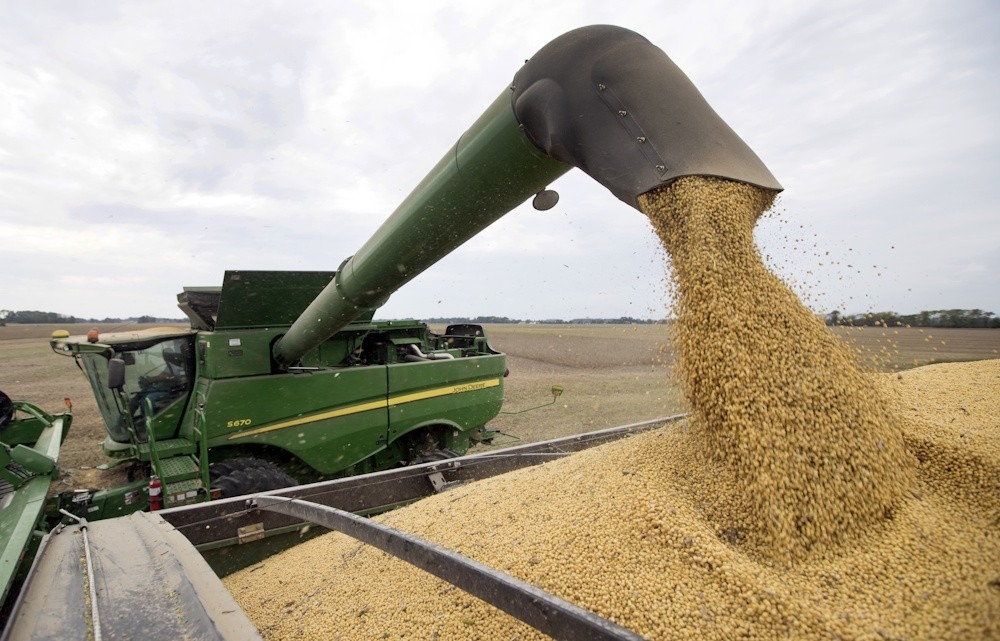
That couldn’t come at a worse time for soybean farmers, as the harvest season is in full swing and some farms are reporting strong yields. And their luck may not shift in the near future, as Beijing increases its dependence on South America — inadvertently supported by the financial lifeline from the US Treasury extended to Argentina in recent weeks. A combine harvester at work during the soybean harvest on a farm located outside St. Peter, Minnesota. A combine harvester operates during a soybean harvest at a farm located outside St. Peter, Minnesota. Last week, the Trump administration announced plans to provide a $20 billion lifeline to Argentina’s central bank, which would facilitate the exchange of US dollars for pesos in an effort to stabilize Argentina’s financial market. Argentina also temporarily eliminated export taxes on grains to assist in stabilizing the peso, but China acted swiftly. According to a report, Beijing purchased “at least 10 cargoes of Argentine soybeans.” Brazil has played a significant role in fulfilling China’s demand for soybeans, as both nations revealed a pact in July aimed at strengthening agricultural trade relations. Consequently, America’s struggling soybean industry is urging the Trump administration to complete its trade negotiations with China. “US soybean farmers have been clear for months: the administration needs to secure a trade deal with China. China is the world’s largest soybean customer and typically our top export market,” Caleb Ragland stated.
Numerous farmers emphasize that time is critical as they begin to harvest this year’s crop. “We’re always hopeful that those negotiations are moving forward, but yet with harvest here, patience may be running thin,” one farmer told, highlighting the numerous challenges facing the industry, including the deportation of essential workers. Trump has acknowledged the demands for action. On Wednesday, Trump attributed the struggles of soybean farmers to China, asserting that Beijing is withholding soybean purchases as a tactic in the ongoing tariff dispute between the two nations. He stated that he intends to make soybeans “a major topic of discussion” during his upcoming face-to-face meeting with China’s President Xi Jinping in South Korea next month. According to White House officials, one reason Trump has focused on the issue is that Rollins has compelled both the president and one of his closest advisers, Treasury Secretary Scott Bessent, to engage with it.
On Tuesday, a photo of Bessent’s phone, went viral, revealing a text from a contact named “BR,” believed to be Rollins. Her messages highlighted the anxiety permeating the Trump administration regarding the challenges faced by the soybean industry, which intensified amid the situation in Argentina. In this “time of uncertainty” for farmers and ranchers, Rollins stated that she is in “constant communication” with the White House and partners across the government. Rollins referred to Trump’s proposal of temporarily allocating tariff revenue to farmers as “a very elegant solution.” She said “To this moment of uncertainty, the ability to offset any payments to the farmers through potential tariff revenue is really where the president wants us to head, and that’s what we’re looking at.”