Japan’s $36 Billion Investment in US Projects with Trump
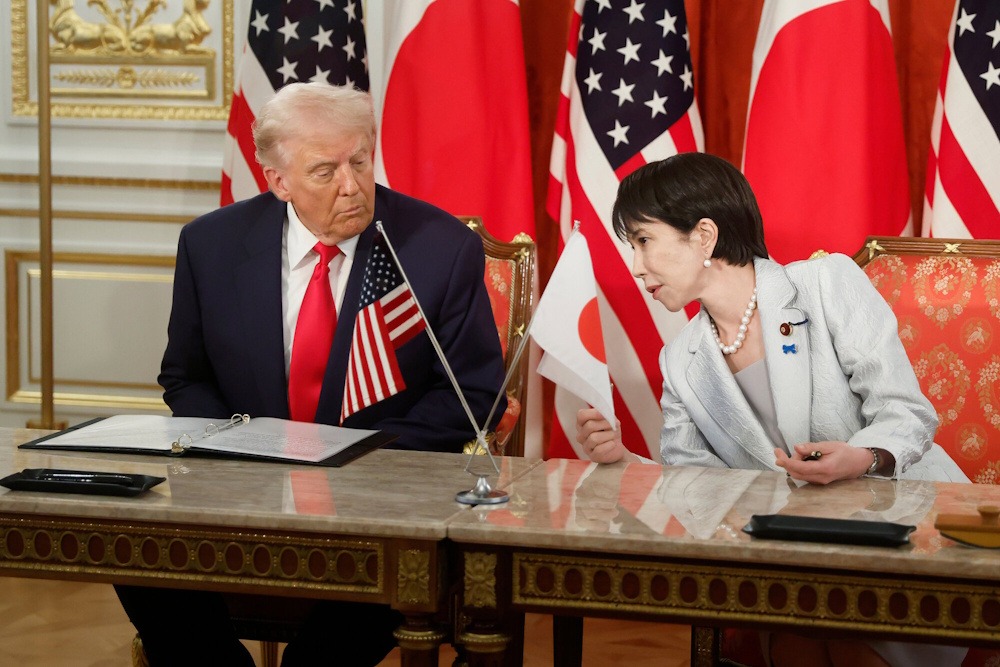
Japan is set to allocate $36 billion towards projects in the US focused on oil, gas, and critical minerals. This investment marks the initial phase of its broader $550 billion commitment established through the trade agreement with President Donald Trump. “Our significant trade agreement with Japan has just been initiated!” Trump posted Tuesday on social media. “The scale of these projects is so large, and could not be accomplished without one very special word: TARIFFS.” Japanese Prime Minister Sanae Takaichi stated that the initiatives aim to establish resilient supply chains by fostering collaboration in sectors vital for economic security, such as critical minerals, energy, and artificial intelligence. “This initiative is fully aligned with its core objectives: promoting mutual benefits between Japan and the United States, ensuring economic security, and fostering economic growth,” she wrote. The most significant investment is a natural gas facility in Ohio that is anticipated to produce 9.2 gigawatts of power, as stated by US Commerce Secretary Howard Lutnick. This substantial project has been characterized by Trump as “the largest in History.” Japan is anticipated to allocate $33 billion towards the gas plant, with leadership from SoftBank Group Corp.’s subsidiary SB Energy, as stated by an official from the Trump administration. Should the plant function at its maximum capacity, it would generate power comparable to that produced by nine nuclear reactors, or approximately the energy usage of around 7.4 million households on the largest US grid managed by PJM Interconnection LLC.
The second project involves a deepwater crude export facility located in the Gulf of Mexico, as stated by Lutnick. The $2.1 billion investment into the Texas GulfLink export terminal, operated by Sentinel Midstream, is anticipated to yield up to $30 billion in annual US crude exports when functioning at full capacity, according to an administration official. Trump’s initial social media post regarding the project generated a degree of confusion, characterizing the investment as a liquefied natural gas facility. Japan is anticipated to allocate resources towards the establishment of a synthetic industrial diamond manufacturing facility, as indicated in Trump’s post, which is expected to be situated in Georgia. Lutnick stated that the diamonds serve as a “critical input for advanced industrial and technological production.” The project is set to secure an investment of $600 million and includes Element Six, a subsidiary of De Beers, as stated by an administration official. “Both governments will continue to work closely together to fine-tune the details and ensure the speedy start of these projects,” stated Minoru Kihara. The long-anticipated announcement signifies progress for the trade and economic agreement that Trump unveiled with Japan in the previous year. It arrives mere weeks prior to Takaichi’s scheduled meeting with Trump in Washington. The selection follows the initial meeting of a joint panel in December to evaluate projects, which are ultimately chosen by Trump himself, guided by recommendations from an investment committee he formed, as well as insights from Japanese officials. The fund aims to catalyze a surge of Japanese investment in essential US sectors and serves as a fundamental component of the tariff agreement, wherein the US president consented to impose levies of 15% on Japanese goods while reducing the tariff on automobiles, a vital engine for Japan’s economy.
The execution of the agreement is anticipated to be a primary focus during the forthcoming meeting between Trump and Takaichi in Washington, scheduled for March 19. Lutnick and Japanese Trade Minister Ryosei Akazawa convened in Washington last week to negotiate the specifics of the initial tranche of investments. Akazawa stated that he does not anticipate projects supported by the $550 billion fund to be characterized by high risk and high returns, indicating that the Japanese are pursuing initiatives that offer stable returns, as opposed to investments with greater uncertainty. Japan is supplying the capital. Infrastructure development is currently underway in the United States. “The proceeds are structured so Japan earns its return, and America gains strategic assets, expanded industrial capacity, and strengthened energy dominance,” Lutnick stated in his Tuesday announcement. The initial investment in a power generation facility is well-timed. The increasing demand from emerging data centers, particularly in pursuit of the artificial intelligence surge, has escalated the expenses associated with securing sufficient energy supplies. The two nations pinpointed prospective projects valued between $350 million and up to $100 billion during Trump’s visit to Japan last year. The framework encompassed investments in energy, artificial intelligence, and critical minerals, featuring participation from SoftBank, Westinghouse, Toshiba Corp., and several other firms. The government-owned Japan Bank for International Cooperation, along with Nippon Export and Investment Insurance, is anticipated to assume prominent roles in the financing of the projects. The extent of financial commitment in direct investment remains uncertain at this stage. Akazawa stated last year that merely 1-2% of the $550 billion mechanism would be comprised of cash investments, with the bulk originating from loans and loan guarantees.
Following the selection process, Japan is allotted 45 business days to provide funding for the initiative, as stipulated in the agreement between the nations. Should Japan decide against funding a project, the United States may reclaim specific revenues or reinstate tariffs, as stipulated in the agreement. This scenario could lead to substantially increased tariffs on Japanese imports entering the United States. Trump initially threatened to increase tariffs to 25%, but subsequently reduced that figure to 15% following Japan’s commitment to enhance investment in the US via the $550 billion fund. Trump has expressed dissatisfaction regarding the speed of executing a comparable agreement with South Korea, a significant rival to Japan in the automotive sector, and has indicated the possibility of increasing tariffs once more. The narrative highlights the connection between the commitments to invest and the corresponding adjustments in tariffs that were implemented. The announcement follows a significant electoral victory for Takaichi earlier this month and coincides with parliament’s preparations to formally re-elect her as premier later on Wednesday. She has committed to emphasizing robust relations with the US. Trump has expressed admiration for Takaichi, extending his wishes for “great success” in her “Conservative, Peace Through Strength Agenda.” William Chou noted that the three projects exemplify the aligned priorities of the US and Japan in the energy, AI, and semiconductor sectors, aligning well with the capabilities and insights of Japanese industry regarding the US industrial landscape. “This announcement ensures political momentum ahead of PM Takaichi’s trip to Washington next month, and demonstrates that Japan is an ally that follows through on its promises,” Chou stated.