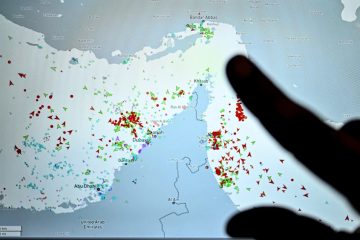
Asia faces more trouble with Trump’s Strait of Hormuz blockade

The decision by US President Donald Trump to blockade the Strait of Hormuz poses a significant threat to the already precarious economic situation facing Asia’s energy-dependent economies, which encompass both America’s allies in the region and China. “For the global economy and markets, the latest developments shift the focus back toward downside risks — pointing to higher oil prices and a larger blow to growth and boost to inflation,” wrote analysts including Jennifer Welch in a note. On Monday, global benchmark Brent crude oil surged by as much as 8.6 percent, exceeding $103 a barrel, while European gas futures experienced a significant spike of nearly 18 percent at one point.
US forces will commence the blockade, which is applicable solely to vessels entering or departing Iranian ports, starting at 10 a.m. On Monday, the US Central Command stated, as reported. The president announced the blockade plans just hours after the US and Iran were unable to reach an agreement during direct talks in Pakistan. Asian nations, including US allies like Japan and South Korea, utilize over 80 percent of the energy that typically passes through the strait. Governments throughout the region have been urgently working to secure alternative oil and gas supplies, implementing strategies to reduce energy consumption such as adjusting air conditioner settings to higher temperatures, and introducing initiatives aimed at alleviating the impact on consumers and businesses.
Tankers linked to Iran, along with those from countries such as China, had been navigating the crucial waterway — activities that the blockade aimed to address. As Trump prepares for his upcoming visit to China in mid-May, Beijing may seek to exert pressure on Washington to remove the blockade. Analysts from BE suggest that China could utilize its control over essential minerals if necessary. “The problem for Asia isn’t just energy, with downstream industries from fertilizers to packaging and even fabric supplies set to take a hit from the blockade,” said Deborah Elms. “This means that this disruption is not a temporary problem,” she stated. “This is a potentially long-term issue, and unfortunately, particularly for Asia, there aren’t a lot of alternatives.” In a distinct analysis, economics examined three potential scenarios regarding the conflict and its impact on the global economy. In the base case, the conflict persists at a diminished intensity, with oil prices averaging $105 a barrel in the second quarter before declining to $85 in the fourth quarter.
In that scenario, global GDP experiences a growth of 2.9 percent this year, while inflation is recorded at 4.2 percent in the fourth quarter. Increased intensity in fighting, coupled with the Strait of Hormuz largely closed for several months, could lead to oil prices soaring to $170. In that scenario, global growth decelerates to 2.2 percent, while inflation concludes the year at 5.4 percent. A lasting ceasefire or the collapse of Iran could lead to the strait reopening sooner, resulting in oil prices returning to pre-war levels. This scenario would see global growth at 3.1 percent and inflation concluding the year at 3.7 percent, as noted by analysts, including Tom Orlik. “The latest developments provide little clarity on which scenario is most likely to play out,” they wrote. “We’ll see how things play out, but right now our base case feels about right on the trajectory — even as details continue to evolve.”