China Launches World’s First Solar-Thermal Power Plant in Gobi Desert
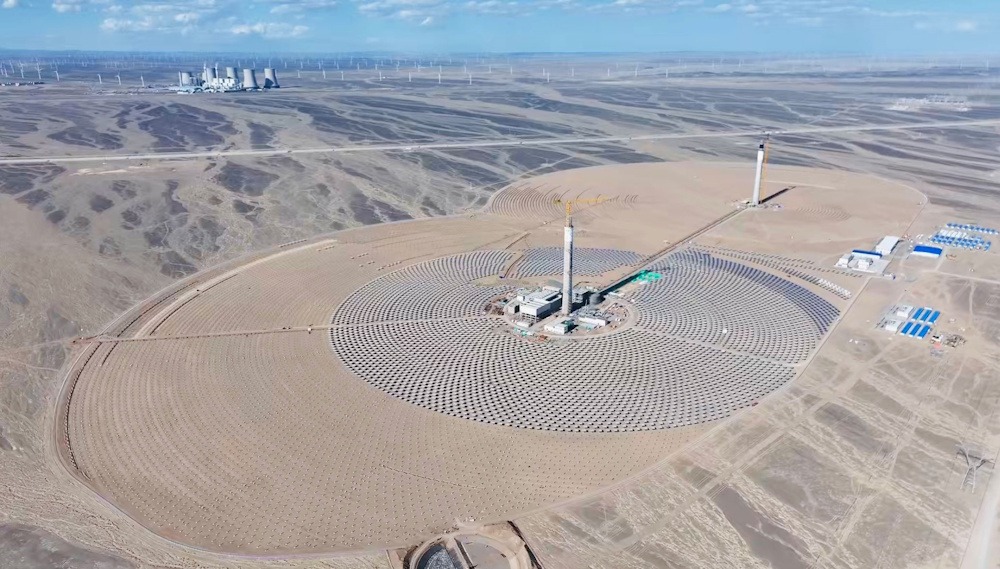
In a groundbreaking development, China has activated a solar thermal power station in the Gobi Desert, a project characterized as a more cost-effective and efficient application of the technology, with significant potential for expansion. The thermal power station constructed by the China Three Gorges Corporation, located in Guazhou County, employs two towers to supply a single turbine system. About 27,000 mirrors have been set up to focus sunlight onto two towers, each standing 200 meters tall and located approximately one kilometer apart. The process generates concentrated heat, melting and storing it at temperatures reaching up to 570 degrees Celsius (1,058 degrees Fahrenheit). The stored heat is utilized to generate steam that powers the turbines, enabling power generation to persist after sunset or in overcast conditions, the report noted.
The report indicated that the dual-tower configuration enables the east tower to harness sunlight during the morning, whereas the west tower gathers it in the afternoon. The tower setup achieves a 25 per cent increase in effectiveness when compared to a single-tower design. The partial overlap of the two mirror fields allows the plant to utilize fewer mirrors, resulting in substantial cost savings, as the mirrors constitute the majority of the construction expenses. Reports says that the dual-tower design and the possibility of future multi-tower systems address the capacity limitations of single-tower plants and facilitate the expansion of solar thermal power generation in China. The Chinese solar thermal plant is integrated into a larger clean-energy hub, unlike the numerous earlier solar thermal projects in Europe and the United States, which functioned as independent plants. Alongside the expansive solar and wind farms in the area, the Chinese plant is expected to supply electricity to approximately half a million households each year. One notable advantage of solar thermal power compared to traditional solar panels is its capacity to produce electricity even after sunset. The technology experienced swift advancement in Spain and the United States over a decade ago, attributed to the substantial government subsidies.
However, it eventually declined as the cost of photovoltaic panels fell sharply, by more than 80 percent, leaving many solar thermal projects struggling financially or facing bankruptcy. China’s approach, in contrast, developed in a distinct manner. Initially, it concentrated on developing a substantial low-cost capacity for photovoltaic and wind energy, particularly in its sunny and windy western provinces, such as Gansu, Xinjiang, and Qinghai. This, in turn, presented a new challenge, as these energy sources were deemed intermittent and were unable to fulfill demand during nighttime or times of low sunlight and wind. According to the report, solar thermal power has emerged as a complementary technology rather than a rival to PV, serving to bridge the gaps, as noted by Wang Zhifeng, a senior researcher at the Chinese Academy of Sciences.
Wang highlighted that almost 60 percent of the solar thermal plant’s expenses are attributed to its mirror systems, which need to be meticulously curved, exceptionally polished, and adept at tracking the sun with remarkable precision. The China has constructed 21 commercial solar thermal power plants, boasting a total capacity of 1.57 million kilowatts. Another 30 projects currently under construction are anticipated to contribute an additional 3.1 million kilowatts of capacity. The 700-megawatt Noor Energy 1 project in the United Arab Emirates stands as the largest operating solar thermal complex in the world. China has also contributed to the development of other significant projects, such as Morocco’s Noor complex and Chile’s Cerro Dominador, where solar thermal power is a crucial component of national clean energy strategies.