Tesla’s India gambit may be symbolic rather than strategic

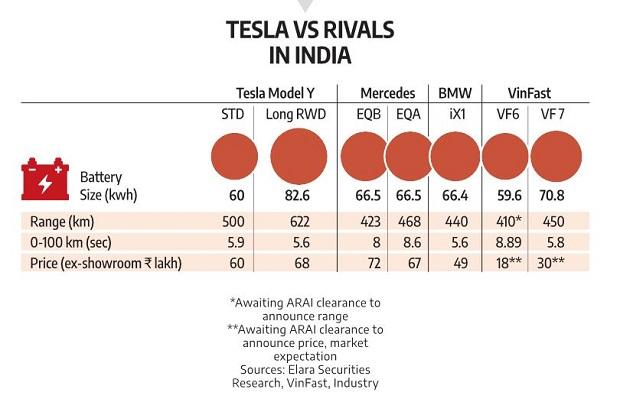
Tesla, the emblematic figure of full self-driving cars, has officially arrived in India. Tesla’s entry into a market consistently boosts the adoption of battery electric vehicles (BEVs). In India, that may not hold true. Tesla’s pricing positions it squarely in the luxury EV segment in India, with the Model Y rear-wheel drive (RWD) at ₹60 lakh [USD 70k] and the Model Y long range at ₹68 lakh [USD 80k] making it unlikely to affect current mass-market EV competitors.
Analysts suggest that Tesla will prioritize establishing the Model Y brand before pursuing expansion in both volume and model offerings. The Model Y is priced at more than six times the average selling price of cars in India, and over the next five years, it is projected to cost 2.4 times more, according to Jay Kale, analyst with investment bank Elara Capital. “In the EU, the US, and China, this ratio is around 1.0–1.5 times, and with that, Tesla’s BEV market share is in the range of 10–15 percent in the EU and China, and 44 percent in the US.” “This translates into an overall PV (personal vehicle) market share of less than 5 per cent in these regions,” Kale said in a note on Wednesday.
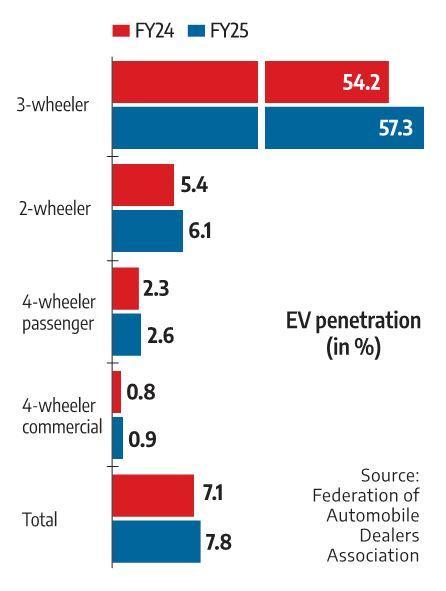
Elara stated that if BEVs make up 10–15 percent of the Indian PV market by 2029–30 (FY30), Tesla is expected to represent 1.5–2 percent. Should BEV penetration reach 30 per cent (bull scenario), Tesla could capture a 3–4.5 per cent share of the PV market, it noted. “Hence, we do not see its entry into India as a major threat to domestic OEMs (original equipment manufacturers), but it could be instrumental in raising awareness about EVs,” Kale said. Kale stated that they believed Tesla’s superior and pioneering software experience would set a benchmark for the EV industry in India, compelling domestic OEMs to enhance their offerings.
Wealth manager Bernstein expressed a similar view. Tesla stated it would prioritize brand building over mainstream volumes. This indicated that local automakers like Mahindra & Mahindra, Maruti Suzuki India, and Tata Motors would experience limited immediate impact. “The situation could change in the medium term as Tesla is working on a sub-$25K affordable EV,” Bernstein added. A research report by financial services firm Macquarie stated that Tesla’s premium entry price does not pose a volume risk for M&M and Tata Motors. It highlighted that the firm’s pricing strategy, the ramp-up of its distribution network, and India’s auto policy would be key variables to monitor.
Analysts at Citi noted that Tesla’s products vary significantly, with target customer segments that do not overlap. At the current price point, potential Mahindra XUV 9e customers are unlikely to shift to Tesla. “The products vary significantly and target customer segments also do not overlap,” Citi stated. “If duties are reduced or if local manufacturing starts, competition could escalate for the Indian OEMs,” it added. In the future, even if an India–US or India–EU free trade agreement is signed, and Tesla imports the Model Y from the US, it will still exceed its current market price of $44,900 (ex-Federal credits), amounting to ₹39 lakh. This remains 24 percent higher than M&M’s 9e (Pack 3, 79 kWh) and 31 percent more than the Tata Harrier EV (Empowered QWD 75 ACFC).
Tesla’s entry into India will face challenges, veterans in the auto industry believe the electric auto major will encounter significant competition unless it introduces its driverless cars. “I personally drive a Tesla occasionally.” “Without the driverless option, it is not an exciting product in Indian conditions,” said an automobile industry veteran. “Moreover, we already have established products in the segment.” India’s premium market segment accounts for 51,000 units annually — just 1 percent of total vehicle sales. Global majors such as Mercedes-Benz, BMW, Audi, and Jaguar Land Rover have established robust ecosystems, including service networks and local assembly lines, for a small share of the market.
In the PV industry, EVs represent only 4.5 percent as of June 2025. In the luxury PV segment, they account for approximately 10 percent, with BMW leading at a 53 percent market share, followed by Mercedes at 33 percent. Tesla faces increasing challenges as global competitors like Chinese EV manufacturer BYD and Vietnamese player VinFast expand into India, implementing superior service strategies. VinFast aims to establish a presence in over 30 cities via its dealership network and has engaged service partners. BYD is actively seeking local partners in India.
Tesla identified India as a potential manufacturing hub in Asia back in 2014. Prime Minister Narendra Modi’s visit to Tesla Motors’ plant in San Jose in September 2015 sparked speculation regarding the company’s potential entry into India. In July 2016, Union Minister Nitin Gadkari visited the Tesla unit, offering land near major Indian ports to facilitate exports to South and Southeast Asian countries. He urged the company to establish India as its Asia manufacturing hub. Despite multiple rounds of negotiations aimed at reducing duties and providing incentives, Tesla has yet to commit to local manufacturing.
Tesla’s entry into India is viewed by many as a strategy to tackle the capacity surplus at its global plants, potentially bringing excess inventory to the Indian market. Tesla currently has a manufacturing capacity of 2.5–3 million units across the US, Germany, and China. Insiders perceive the India entry as more symbolic than substantial — a branding effort. It is premature to determine if India will emerge as a core market in South Asia for Tesla. In China, its entry transformed the EV market. Previously, EVs were primarily regarded as a commercial option instead of an aspirational choice.
“The real shift happened when Tesla opened its Gigafactory at Shanghai; since then, EV penetration took off in China,” Elara stated. “It was Tesla that was the first EV OEM globally to generate buzz about EVs, positioning them as aspirational products, which started attracting customers,” it added. In 2019, China’s EV penetration stood at 3.8 percent. Tesla launched in December of that year and commenced car sales in 2020. China’s EV penetration has been steadily increasing, reaching 24.6 percent in 2024. Kale asserts that emphasizing the aspirational aspect is crucial for encouraging consumers to transition to EVs — a position where Tesla excels. This shift may also occur in India.
Tesla, in contrast to traditional auto giants like Volkswagen and Honda, has opted against significant investment in conventional advertising channels such as television. It has instead depended on celebrity influence and word-of-mouth, which have contributed to its image as a premium, niche brand. Early adopters included actor Brad Pitt, Google cofounders Larry Page and Sergey Brin, eBay’s first president Jeff Skoll, and Xiaomi Chief Executive Officer Lei Jun. Will it implement a comparable strategy in India? Will it influence the country’s EV landscape? The answers will emerge as Tesla covers ground in India.