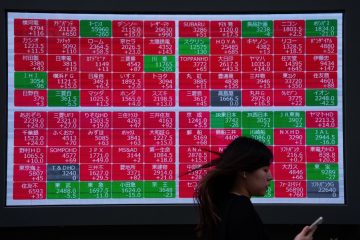
Asian Stocks Poised for Biggest Annual Surge in Eight Years
Asian stocks exhibited a lack of direction on the final trading day of a year marked by investors largely disregarding tariff-related uncertainties and favoring AI chip stocks. Meanwhile, the dollar’s poor performance throughout the year has allowed the euro and sterling to maintain their strength. Precious metals have captured significant attention as the year draws to a close, with silver’s remarkable rally pushing its annual gains beyond 160 percent. However, on Wednesday, the metal saw a 1 percent decline as traders took the opportunity to book profits. Gold has strengthened slightly and is poised for a 66 percent increase in 2025, as the three-year rally continues unabated. Japanese markets will remain closed for the remainder of the week, and with the majority of markets also closed on Thursday in observance of the New Year’s Day holiday, trading volumes are expected to be low and market movements subdued.
On Wednesday, MSCI’s broadest index of Asia-Pacific shares outside Japan declined by 0.17 per cent as investors assessed the minutes from the Federal Reserve’s December meeting, which highlighted significant divisions among policymakers regarding U.S. rates. The index is set to achieve a 27 per cent increase for the year, marking its most significant rise since 2017, primarily driven by a robust rally in chipmakers due to the surge in artificial intelligence-related stocks. China’s blue-chip index inched higher, on track for an 18 per cent increase for the year, while Hong Kong’s Hang Seng slipped 0.7 per cent but aimed for a 28 per cent gain for 2025 as investors dismissed trade war concerns. South Korea’s Kospi stands out as the top-performing major stock market globally, experiencing a remarkable 76 percent increase over the year, largely driven by the successes of SK Hynix and Samsung.
“Notwithstanding a few little shocks, the year has been terrific for investment returns,” said Kyle Rodda. The gains have been somewhat concentrated, yet the interplay of the AI boom alongside supportive monetary and fiscal policies has propelled risk assets upward, nearing record levels. Markets have navigated a year marked by tariff wars, the longest government shutdown in U.S. history, turbulent geopolitical tensions, and challenges to central bank independence, all while achieving notable gains worldwide. “Heading into 2026, AI is still the anchor theme, but in a different phase: less hype, more adoption and return on investment scrutiny,” said Charu Chanana. “The biggest risks are an unwinding of crowded positioning in both AI and precious metals,” Chanana said. Add to that a market that exhibits excessive confidence in a smooth rate trajectory, alongside the real economic effects of tariffs that were not entirely apparent in 2025 beginning to manifest in 2026, leading to a rapid repricing of inflation expectations and profit margins. Investor attention in the coming year will center on the Fed’s rate trajectory, following the central bank’s recent indication of only one anticipated rate cut, while traders are factoring in a minimum of two additional cuts.
The minutes from the December meeting highlighted the difficulties confronting both policymakers and markets. “Most participants” ultimately supported a cut earlier this month with “some” arguing that it was an appropriate forward-looking strategy “that would help stabilize the labor market” after a recent slowdown in job creation. Cash Treasuries remained untraded as a result of the holiday in Japan, with Treasury futures showing minimal movement. Yields on 10-year notes were recorded at 4.1258 percent on Monday, reflecting a decline of 45 basis points this year. In currencies, the dollar maintained its position on Wednesday but was on track for a 9.4 percent decline for the year, marking its largest drop since 2017, while the euro and sterling enjoyed significant yearly gains. In 2025, oil prices experienced a decline of over 10 per cent, with Brent poised for its longest series of annual losses to date. This downturn was driven by a supply surplus amid a backdrop of wars, increased tariffs, and OPEC+ production adjustments, alongside sanctions imposed on Russia, Iran, and Venezuela.