Asian markets pull back from all-time peaks as investors cash in on gains
Asian stock markets, spanning from Tokyo to Taipei and Seoul, experienced a decline from their all-time highs on Tuesday, as investors opted to secure profits after robust tech-driven rallies in recent weeks. Sentiment faced some challenges due to weak US economic data, while differing opinions among Federal Reserve officials obscured the outlook for a potential interest rate cut in December. The US dollar climbed to a peak not seen in nearly nine months against the yen, and reached a three-month high versus the euro. Australia’s central bank maintained optimism for rate cuts by indicating that some of last month’s inflation surge was attributed to temporary factors, leading to a decline in the Australian dollar and assisting stocks in reducing their losses. Overnight, a rally in US tech shares buoyed both the US S&P 500 and Nasdaq; however, futures indicated declines of 0.3 percent and 0.5 percent, respectively. Rodrigo Catril remarked that the prevailing narrative for markets persists as “tech stocks powering Wall Street higher, even as broader market sentiment remained cautious.” “US economic activity presents a narrative of two opposing forces: an AI boom driven by major technology companies, and a manufacturing sector grappling with tariff uncertainties and increased costs.”
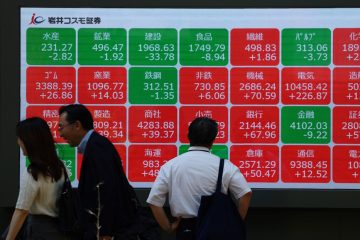
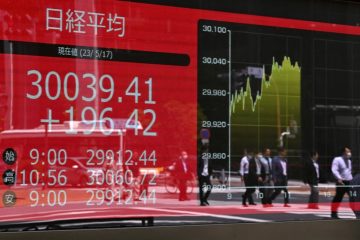
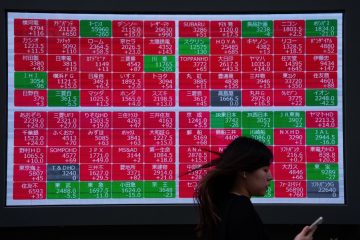
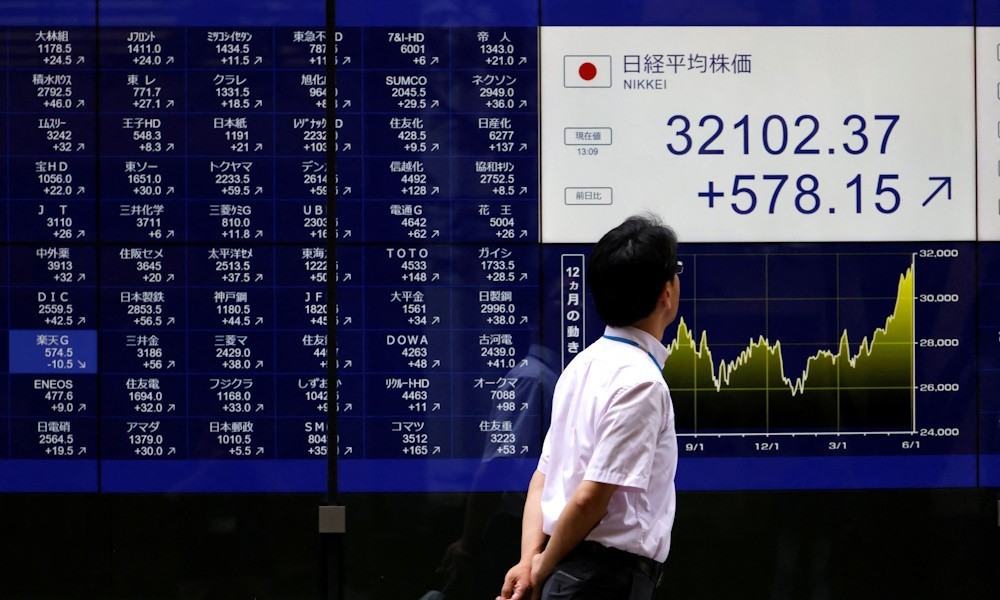
Japan’s Nikkei increased by 0.4 per cent, achieving a record-high of 52,636.87, although it subsequently declined by 0.4 per cent. Taiwan’s TAIEX initially rose by as much as 0.8 percent, reaching a record high, before experiencing a decline of 0.3 percent. South Korea’s KOSPI fell by 1.7 percent after a notable 2.8 percent increase on Monday, when it achieved an all-time high. Hong Kong’s Hang Seng increased by 0.2 per cent, while onshore-listed Chinese blue chips saw a decline of 0.4 per cent. Australia’s stock benchmark experienced a decline of 0.7 per cent, having previously fallen by as much as 0.9 per cent. The Reserve Bank of Australia maintained its rates on Tuesday, as anticipated, expressing caution about further easing in light of elevated core inflation, stronger consumer demand, and a resurgence in the housing market. Concurrently, it stated, “the board’s judgment is that some of the increase in underlying inflation in the September quarter was due to temporary factors.”
The Aussie dollar experienced an initial decline of up to 0.3 per cent, before recovering slightly to stand at 0.1 per cent lower, priced at $0.6531. The US dollar exhibited broad strength as traders scaled back their expectations for near-term easing by the Federal Reserve, while US Treasury yields remained near three-week highs. The currency increased by 0.2 percent, reaching 154.48 yen for the first time since February 13. The euro fell by 0.2 percent to $1.1498, marking its first decline since August 1. The US dollar index, which assesses the currency in relation to the euro, yen, and four other counterparts, surpassed 100 for the first time in three months. On Monday, Fed officials presented differing perspectives on the current state of the economy and the associated risks, as official economic data remains unavailable due to the federal government shutdown. Fed Governor Stephen Miran reiterated the argument for substantial rate cuts, whereas Chicago Fed President Austan Goolsbee expressed caution regarding additional reductions as inflation continues to be notably above the central bank’s 2 percent target. The Federal Reserve reduced interest rates last week; however, Chair Jerome Powell indicated that this may have been the final reduction for the year.
On Monday, reports from manufacturers in the private Institute for Supply Management survey revealed a troubling outlook for the factory sector, indicating that US manufacturing contracted for an eighth consecutive month in October as new orders continued to be lackluster. Traders are currently estimating a 65 percent likelihood of a rate cut in December, a decrease from the 94 percent observed just a week prior, according to the sources. “There was quite a bit of doubt cast on the likelihood of a follow-up December rate cut,” said Shaun Osborne, chief currency strategist at Scotiabank. “I do not remember, throughout my years of observing these markets, such a notable public division among Fed policymakers regarding the policy outlook.” Gold declined by 0.3 percent to approximately $3,990 per ounce, attempting to stabilize after a significant drop from its record high in mid-September. Crude oil prices experienced a slight decline as markets assessed OPEC+’s choice to halt output increases in the first quarter, amidst ongoing worries about a potential supply glut. Brent crude futures dipped 0.2 percent to $64.75 a barrel, while US West Texas Intermediate crude also fell 0.2 percent to $60.92 a barrel.