Xi’s Vision: A New Global Order with Russia and India by His Side
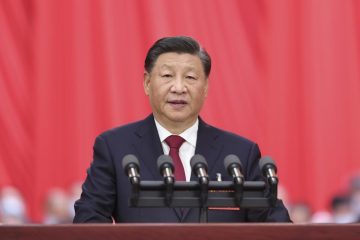
On Monday, Chinese President Xi Jinping articulated his vision for a new global security and economic order that emphasizes the “Global South,” presenting a direct challenge to the United States. During a summit in the Chinese port city of Tianjin, Xi welcomed over 20 leaders from non-Western countries for the Shanghai Cooperation Organisation. This China-backed initiative gained renewed momentum with the attendance of Russian President Vladimir Putin and Indian Prime Minister Narendra Modi. This declaration came during a summit that featured the leaders of Russia and India. In a pointed remark, Xi stated, “We must continue to take a clear stand against hegemonism and power politics, and practise true multilateralism,” seemingly targeting the United States and the tariff policies of President Donald Trump. “Global governance has reached a new crossroads,” he added.
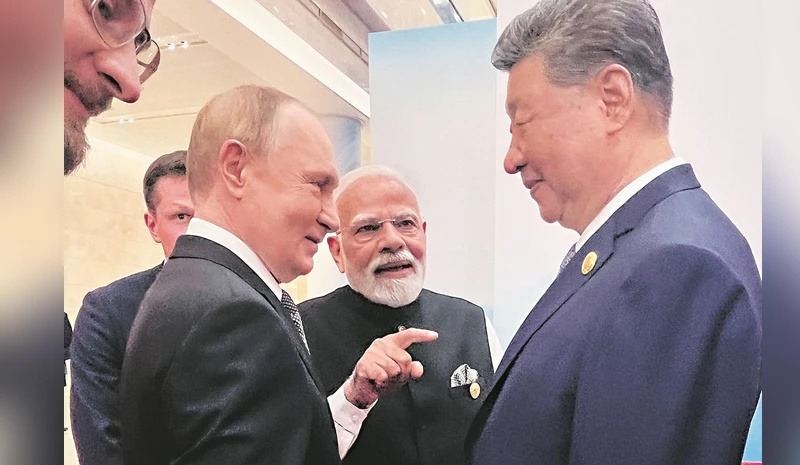
In a striking visual aimed at illustrating unity, Putin and Modi were depicted holding hands as they approached Xi with a sense of camaraderie prior to the summit’s commencement. The three men stood shoulder-to-shoulder, sharing laughter as they were encircled by interpreters. “It’s hard to tell if the scene was choreographed or improvised, but it doesn’t really matter,” wrote Eric Olander, editor-in-chief of The China-Global South Project, a research agency. “If the US president and his acolytes believed they could leverage tariffs to coerce China, India, or Russia into compliance, that (encounter) suggests a different narrative.” Following the summit, Modi and Putin traveled together in the Russian leader’s armoured Aurus limousine on their way to a bilateral meeting. Modi expressed on X, “Conversations with him are always insightful.” During the bilateral meeting, Putin referred to Modi in Russian, stating, “Dear Mr Prime Minister, dear friend.” China and India have emerged as the largest purchasers of crude oil from Russia, which holds the position of the world’s second-largest exporter. Trump has implemented new tariffs on India concerning its purchases, while China remains unaffected by these changes.
Established over twenty years ago, the Shanghai Cooperation Organization (SCO), headquartered in Beijing, remains relatively obscure beyond its regional confines, functioning primarily as a security bloc. China, Russia, and four Central Asian states have been identified as founding members. India became a member in 2017. In his recent address, Xi refrained from outlining specific measures within what he termed his “Global Governance Initiative.” This initiative represents the latest in a succession of policy frameworks emerging from Beijing, aimed at bolstering China’s leadership while contesting the US-dominated international organizations established in the aftermath of World War Two. In a recent statement, Xi advocated for what he termed more inclusive economic globalisation, highlighting the disruptions stemming from Trump’s tariff policies. He emphasized the SCO’s “mega-scale market” and the economic opportunities it presents.
Putin, whose country has strengthened economic and security ties with China in the wake of the Ukraine war, stated that the SCO has revitalized “genuine multilateralism,” highlighting the growing use of national currencies in mutual settlements. “This, in turn, lays the political and socio-economic groundwork for the formation of a new system of stability and security in Eurasia,” Putin stated. “This security system, unlike Euro-centric and Euro-Atlantic models, would genuinely consider the interests of a broad range of countries, be truly balanced, and would not allow one country to ensure its own security at the expense of others.”
Xi has proposed the establishment of a new SCO development bank, marking a significant advancement towards the bloc’s enduring goal of creating an alternative payment system that bypasses the US dollar and mitigates the influence of US sanctions. Beijing has announced it will extend 2 billion yuan ($280 million) in free aid to member states this year, alongside an additional 10 billion yuan in loans to a SCO banking consortium. China is set to establish an artificial intelligence cooperation center for SCO nations, which have also been invited to take part in China’s lunar research station, according to Xi.
Beijing has seized the summit as a chance to repair its relationship with New Delhi. During his first visit to China in seven years, Modi and Xi reached an agreement on Sunday, emphasizing that their nations are development partners rather than rivals. The leaders also explored avenues to enhance trade between their countries. In a significant event, Xi is set to preside over a massive military parade on Wednesday in Beijing, where he is anticipated to be joined by Putin and North Korean leader Kim Jong Un. The upcoming parade, commemorating the 80th anniversary of Japan’s surrender in World War Two, is set to showcase China’s latest military technology. Analysts suggest that this display of force is intended to intimidate and deter potential rivals.