Troops Are Not the Answer for Chicago Violence, Say Families
Delphine Cherry understands better than most the persistent nature of violent crime in Chicago. In 1992, her teenage daughter was tragically gunned down in one of the city’s most notorious neighborhoods, a bystander caught in the crossfire of a gang shootout. Two decades later, in a suburb located just south of the city, it took her son. “You don’t think it’s going to happen twice in your life,” she said. Chicago has been preparing for weeks for President Donald Trump’s anticipated deployment of National Guard troops to the nation’s third-largest city. While Trump stated that the troops would assist in combating crime in a city he labeled as a hellhole, his administration has remained reticent regarding the specifics of the operation, such as its start date, duration, troop numbers, and their involvement in civilian law enforcement.
Trump has fluctuated in his stance on deploying troops to Chicago, at times asserting he would take unilateral action to send them, while at other moments indicating a preference to direct them to New Orleans or another city in a state where the governor is requesting assistance. He stated this week that Chicago is likely to be next after National Guard troops are deployed to Memphis. Despite Chicago’s long-standing reputation for high rates of gun violence among major American cities, city and state leaders are largely against the proposed operation, labeling it as political theater. Even those most directly impacted, including individuals who have lost loved ones to violent crime, question how the deployment of troops could yield any enduring impact on the battle against it.
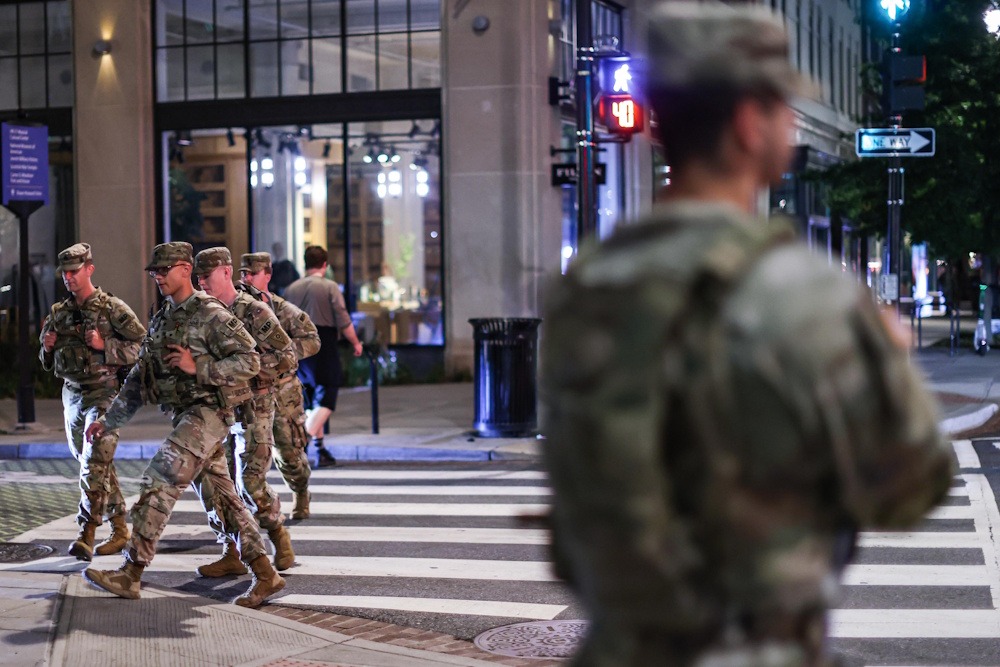
In Los Angeles and Washington, DC, troops served in the capacity of guards. The uncertainty surrounding the Chicago deployment raises questions, yet the utilization of National Guard troops in Los Angeles and Washington this summer may provide valuable insights. In June, Trump sent thousands of Guard troops to Los Angeles in response to protests regarding his administration’s immigration crackdown in the area. Initially assigned to guard federal property, the troops also extended their role to protect immigration agents during raids and participated in a display of force at a park located in a heavily immigrant neighborhood of LA, which local officials suspect was intended to instill fear. In August, Trump declared his intention to place Washington’s police force under his control and to mobilize federal forces aimed at reducing crime and homelessness in the area. The deployed troops have conducted patrols around Metro stations and in the areas of the nation’s capital that attract the most tourists. However, they have also been observed collecting litter and raking leaves in municipal parks. The White House disclosed that over 2,100 arrests occurred in Washington during the initial weeks following Trump’s announcement of mobilizing federal forces. Mayor Muriel Bowser acknowledged the federal deployment’s role in reducing crime, noting an 87 percent decrease in carjackings. However, she also expressed concern over the frequent immigration arrests conducted by masked ICE agents. Nonetheless, an unusually high rate of cases being dropped has raised concerns among some, including at least one judge, about whether prosecutors are making charging decisions prior to thorough investigation and vetting of the cases.
Washington stands out as a federal district governed by laws that grant Trump the authority to assume control of the local police force for a period of up to 30 days. The choice to deploy troops in an effort to combat crime in other cities governed by Democrats would signify a significant escalation. The Trump administration has not disclosed the specific roles of the troops or the areas of Chicago in which they will operate; however, they have made a clear commitment to a surge of federal agents focused on immigration enforcement. The city’s sanctuary policies are recognized as some of the most robust in the nation, prohibiting local police from collaborating with federal immigration enforcement. Chicago is not the sole Democratic-led city in Trump’s focus; he has also identified Baltimore as a probable target. However, Trump appears to hold a distinct disdain for the Windy City, cautioning in a social media post reminiscent of Apocalypse Now earlier this month: ‘I love the smell of deportations in the morning.’ Chicago is on the verge of discovering the reason behind its designation as the Department of WAR. The president’s criticism, however, frequently centers on the approach taken by the city’s and state’s Democratic leaders in addressing crime.
Mayor Brandon Johnson and Illinois Gov. JB Pritzker have consistently highlighted a decrease in crime in Chicago, advocating for increased federal funding for prevention programs rather than deploying the National Guard. The city recorded 573 homicides last year, translating to 21 per every 100,000 residents. That represents a 25 percent decrease compared to 2020 and reflects a lower rate than in several other major US cities. As is the case in many large urban areas, violent crime in Chicago is not uniformly distributed, with a significant concentration of shootings occurring on the South and West sides. “If it was about safety, then the Trump administration would not have slashed $158 million in federal funding for violence prevention programs this year,” said Yolanda Androzzo, executive director of gun violence prevention nonprofit One Aim Illinois. Victims of violent crime express skepticism about the ability of troops to effect enduring change. Following the tragic death of Cherry’s 16-year-old daughter, Tyesa, who was struck by a stray bullet fired by a 14-year-old at rival gang members in Chicago’s Gold Coast neighbourhood, the heartbroken mother relocated her family to Hazel Crest, a suburb located just south of the city.
We were making arrangements for prom. “She was going on to college to be a nurse,” Cherry said. In 2012, her son, Tyler, was fatally shot in the driveway of the family’s suburban home, two decades after Tyesa was killed. Despite becoming an antiviolence advocate following the tragic deaths of her children and serving on the board of One Aim Illinois, Cherry expresses skepticism about the effectiveness of deploying troops to combat crime in Chicago, suggesting that it may actually increase danger on the streets. “They’re not going to ask questions,” Cherry said of the National Guard. They are trained to eliminate targets immediately. Trevon Bosley, just 7 years old at the time, lost his 18-year-old brother, Terrell, who was shot and killed in 2006 while unloading drums outside a church before band rehearsal. He believes that sending in troops is not the solution.
“There is so much love and so much community in Chicago,” said Bosley, whose brother’s killing remains unsolved. There are communities in need of assistance. When those resources are provided, they become equally as beautiful as downtown, equally as beautiful as the North Side. Similar to Johnson, Pritzker, and other opponents of the anticipated troop deployment, Bosley believes that improved funding could significantly benefit areas of the city experiencing the highest levels of crime and poverty. “It’s not like we have a police shortage,” Bosley said. The National Guard and police arrive at the scene following a shooting incident. They have not appeared previously. That is neither halting nor rescuing anyone.