Tesla Sales Surge Post-Musk Boycotts

In the past three months, sales of Tesla vehicles experienced an increase following a challenging year marked by boycotts related to Elon Musk’s political views; however, they still did not meet expectations. The company announced on Thursday that sales increased by 6 percent to 358,023 during the three months ending in March, marking the first time in three years that it has recorded a first-quarter rise compared to the same period the previous year. The rise comes after a year marked by declining sales, attributed to an outdated product lineup and boycotts in response to Musk’s right-wing political positions.
Nevertheless, the outcomes fell short of investors’ expectations, prompting significant selling on Thursday. One reason was that sales were 6 percent lower than the 381,000 that financial analysts had anticipated, according to a survey. Sales for the three months ended in December showed a significant decline. Tesla faces challenges with diminished demand following the September expiration of a $7,500 tax credit for EV buyers, impacting sales throughout the industry. The company is optimistic that the introduction of more affordable versions of Tesla models X and 3 late last year will ultimately boost sales. Tesla is now producing a self-driving Cybercab that features no steering wheel, aiming to attract customers.
Information regarding the new offerings may be revealed on April 22, coinciding with Tesla’s quarterly earnings report. Financial analysts anticipate that the company will report a net income approximately doubled to 25 cents a share on $23 billion in revenue, as stated. The significant selling on Thursday resulted in a 5.4 per cent decline in Tesla stock, bringing it down to $360.59 per share. Nevertheless, the stock is currently trading 30 percent higher than it was a year ago, and its valuation remains exceptionally high—181 times expected earnings compared to 22 times for the broader stock market.
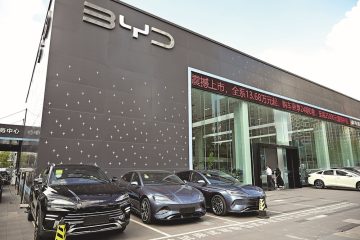
This represents a marketing triumph for Musk, who has been urging investors to shift their attention away from car sales and concentrate instead on the company’s potential to lead in a future where car ownership declines, self-driving Tesla robotaxis are ubiquitous, and Tesla’s Optimus robots are replacing humans in both factories and homes. Before that future arrives, if it indeed does, European and Chinese EV manufacturers are capturing market share. Chinese manufacturer BYD recently announced that it produced 2.26 million electric vehicles last year, surpassing Tesla’s 1.64 million, thus establishing a new record.