Chinese shipping corporations struggle with President Trump’s port fees
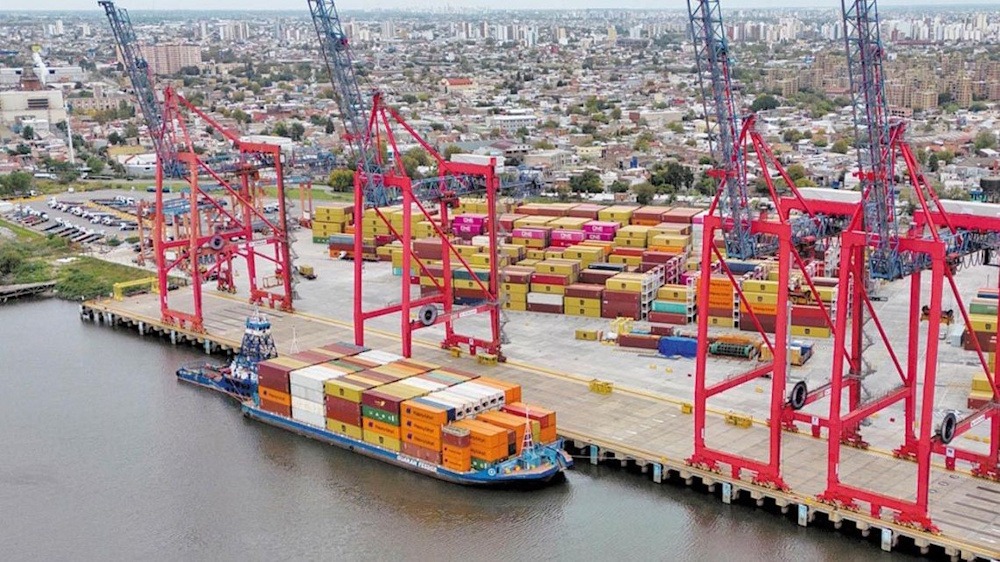
Additional expenses stemming from President Donald Trump’s US port fees signal further challenges for Chinese container shipping companies, which are already grappling with an intensifying trade war and declining freight rates. Cosco Shipping Holdings Co. and Orient Overseas International Ltd are poised to face significant challenges due to the US Trade Representative policy that will take effect on Tuesday. In a recent reciprocal action, China declared sanctions on the US branches of Hanwha Ocean Co. earlier on Tuesday and initiated an investigation into the effects of the USTR’s Section 301 measures on its maritime sector. Last week, China imposed special fees on certain US ships. That led Trump to threaten 100 percent tariffs and software export restrictions — although his administration later indicated a readiness to de-escalate tensions. Cosco Shipping, anticipated to announce lower third-quarter earnings, may encounter additional fees ranging from $1.5 billion to $2.1 billion in 2026, as per estimates from HSBC and Citigroup. According to analyst Parash Jain, OOIL could potentially reach $654 million. Non-Chinese carriers will experience minimal effects, as they are able to utilize ships not built in China on US routes, which come with considerably reduced fees.
“Other lines have the opportunity to reduce the extra cost burden by swapping out China-built ships, but the likes of Cosco cannot change their nationality,” stated Simon Heaney. “There is no workaround available to them.” The US fees, initially revealed in April, are a component of Trump’s strategy to reshape global trade and counteract Beijing’s growing influence by focusing on Chinese owners or vessels constructed in China. Meanwhile, Chinese shipments grew 8.3 per cent in September, marking the fastest pace in six months, while shipments to the US plunged 27 per cent. The impact on freight rates is expected to be minimal, as shipping companies are likely to discover methods to bypass the US port fees. Freight rates have declined from the peaks observed in June 2024. According to Jain, volume growth is experiencing a slowdown after being front-loaded since last year, influenced by worries regarding the earlier US East Coast port strikes and tariff issues. “Overcapacity remains a teething issue for the sector, particularly with a weakening demand outlook,” he stated. Amid the ongoing trade tensions between China and the US, Chinese carriers remain steadfast in their approach.
Orient Overseas Container Line Ltd. stated last month its commitment to the US market “despite the financial burden imposed by these fees,” while Cosco Shipping expressed during an earnings call its intention to “refine” its transpacific product mix. According to Drewry’s Heaney, operators such as Cosco are currently able to sustain US routes due to government support; however, the increasing fee structure will ultimately challenge that commitment over time. “Bottom-line pressure is a certainty when it comes to guidance for the quarters ahead,” stated analyst Kenneth Loh. “Liners wouldn’t see any impact from the USTR levies until well into the fourth quarter.” Loh added that guidance revisions in the coming quarters are likely once there’s greater clarity on the actual imposition and enforcement of the levies. Meanwhile, China’s retaliatory fees are anticipated to have minimal impact on the container shipping sector, as major carriers, including AP Moller-Maersk A/S, have limited involvement in the US, according to HSBC and BI. The container shipping outlook appears muted as we approach the fourth quarter, with earnings anticipated to decrease both sequentially and year-on-year, stated Judah Levine, head of research at cargo booking platform Freightos. Carriers are significantly increasing the number of transpacific blank sailings, which involves skipping a port or canceling a voyage.
“We’re going to see carriers try very hard to manage capacity to keep rates from falling too far, but this is likely kind of the state of affairs as we move forward,” Levine stated. China continues to be pivotal in global trade dynamics, even with the rising shipping demand from areas such as Southeast Asia, he added. The container shipping industry’s center of gravity is swiftly shifting from the transpacific to emerging growth regions, with intra-Asia services on the rise, while Latin America and Africa also present promising opportunities for growth, stated BI’s Loh. According to Arya Anshuman, Taiwan’s Evergreen Marine Corp., Wan Hai Lines Ltd., and Yang Ming Marine Transport Corp. are experiencing declines this quarter, influenced by weaker global demand and decreasing spot rates. Estimates indicate that Japan’s Nippon Yusen KK and Mitsui OSK Lines Ltd. likely experienced a quarterly net income decline of 62 per cent and 68 per cent, respectively.