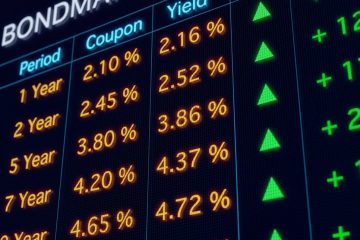
Bond Price Accuracy Jumps 34% in HSBC Quantum Trial
HSBC Holdings Plc announced a groundbreaking achievement, claiming a world-first in the application of quantum computing within financial markets. This development comes as competition heats up among major Wall Street firms to integrate this advanced technology into their everyday operations. The London-headquartered bank announced on Thursday that it utilized International Business Machines Corp.’s most-advanced Heron quantum processor to achieve a 34% enhancement in forecasting the likelihood of a bond trading at a specific price. HSBC and the US technology giant utilized quantum processing on an anonymized dataset of European bond trading, discovering that it could greatly improve market efficiency.
This represents a significant advancement, as it is the first occasion where a bank has utilized real trades at scale to showcase the advantages provided by the emerging technology, which until now has primarily been confined to academic research and specialized tech companies. Companies such as Alphabet Inc., IBM, and Microsoft Corp. are pursuing the next frontier by investing billions of dollars, yet the path to practical applications seems to be lengthy. “Is this a ‘Sputnik moment’ for quantum? My instinct is yes,” said Philip Intallura, as he reflected on the crucial event that ignited a space race between the US and Soviet Union during the Cold War. “It will create a flurry of activity,” he added, as others step up efforts to harness the technology. HSBC’s trial focused on exploring the potential applications of quantum computing in over-the-counter trading markets, where assets are exchanged directly between two counterparties, bypassing any intermediary such as an exchange or broker. Intallura stated that although their trial wasn’t a live trade, it was a real-world, production-scale demonstration. Tech firms have led the charge in quantum computing development, yet financial services giants such as JPMorgan Chase & Co., Goldman Sachs Group Inc., Citigroup Inc., and HSBC are also making significant investments in this field, attracted by its promising advantages. Consulting firms McKinsey & Co. and KPMG assert that it could significantly improve banks’ capabilities in managing risks, optimizing portfolios, detecting fraud, and predicting asset prices across different market scenarios.
New research indicated that revenue from quantum computing is projected to soar to as much as $72 billion in a decade, up from approximately $4 billion last year, driven by advancements in sectors such as chemicals, life sciences, and finance. “For banks, this technology brings significant gains, like in price prediction where even a percentage point makes a big difference,” said Henning Soller. “If one bank is able to start using quantum computing to develop a program, then the others will be developing it the next day and people will not sleep until they have it,” stated Miklos Dietz. “When it arrives, it will be explosive.”Quantum computing is founded on the principles that support the astonishing mechanics of quantum physics. Similar to traditional computers, quantum computers utilize tiny circuits to execute calculations; however, they operate in parallel rather than sequentially. This enables the resolution of intricate issues at significantly quicker rates than those achieved by traditional processors. In a significant development, Alphabet’s Google announced late last year that its newest quantum processor, Willow, had accomplished a task in five minutes that the most advanced supercomputers in the world would not have been able to tackle even if they had been operating on it since the dawn of the universe. Josh Freeland, global head of algo credit trading at HSBC, remarked that during the trial, a team of 16 physicists, along with machine learning and artificial intelligence experts, were “working around the clock,” attempting to replicate the capabilities of the quantum computer.
“If you could get something like this result every day, that would be quite something,” said Freeland. “We spend all day looking for single-digit improvements, because when you repeat that thousands of times a day, it can really make a difference.” Other banks have also been announcing their own advancements in quantum computing. Consider JPMorgan. In March, it announced that it had generated and certified so-called truly random numbers using a quantum computer, marking a world-first that the bank anticipates will have applications in encryption, security, and trading. According to a paper published in the scientific journal Nature, researchers created the sequence using a machine developed by Quantinuum. Last year, KPMG stated that the technology was still in an early prototype phase, yet it may be approaching its inflection point. “We have great confidence we are on the cusp of a new frontier of computing in financial services, rather than something that is far away in the future,” said HSBC’s Intallura.